The Complete Guide to Rebuilding Your Energy After a Schedule Change
Quick Answer: A schedule change costs energy for three separate reasons that resolve on three different timelines. Your circadian timing shifts at roughly one hour per day, so a two-hour change takes about two days to realign but two to three weeks to feel normal. Your decision load spikes because nothing is automatic yet, which resolves in three to four weeks as habits form. And your sleep debt accumulates quietly in week one and then compounds. The levers that actually work are morning light, a fixed wake time, and deliberately reducing decisions in the first fortnight.
It is not a harder schedule. The hours are similar, the work is the same, and you are somehow exhausted by Wednesday in a way you were not in August. Three different things are draining you at once, and it helps enormously to be able to tell them apart.

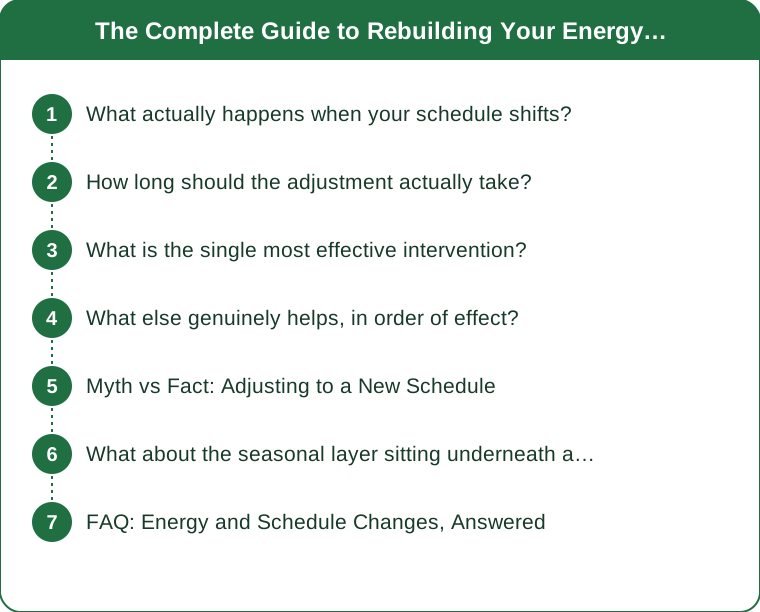
What actually happens when your schedule shifts?
Your circadian system has to re-time itself, and it does so slowly. The internal clock adjusts at approximately one hour per day when it has strong light cues, and considerably slower without them. A schedule that moves your wake time forward by 90 minutes is asking for a realignment that takes several days at best.
And it is not one clock but many. Core body temperature, cortisol release, melatonin onset, digestion, and alertness all shift at slightly different rates. During the transition they are temporarily out of alignment with each other, which is why you can be simultaneously sleepy and unable to sleep.
Shifting earlier is harder than shifting later. The human circadian period runs slightly longer than 24 hours for most people, so delaying is easy and advancing is a fight. September schedules almost universally shift earlier, which is why this particular change is so consistently unpleasant.
Meanwhile, every routine you had is now invalid. When you leave, what you eat, when you train, where you park - all previously automatic, all now requiring conscious thought.
Decision-making is metabolically and psychologically costly. The specific fatigue of a new schedule is heavily a decision-load fatigue, and it is why the tiredness feels mental rather than physical.
Then sleep debt arrives on top. If the new schedule cuts even 40 minutes a night, you accumulate over three hours of debt in a working week. Sleep debt does not present as sleepiness for most adults - it presents as irritability, poor focus, and a craving for sugar in the afternoon, which people then attribute to the job rather than the sleep.
How long should the adjustment actually take?
Circadian realignment: roughly one day per hour of shift, with good light exposure. A one-hour change is essentially done in a couple of days; a three-hour change takes the better part of a week.
Subjective normality: two to three weeks. This is consistently longer than the physiological realignment, and the gap is where people conclude something is wrong with them.
Habit automaticity: three to four weeks minimum, and considerably longer for complex routines. The research on habit formation gives a wide range with a median around two months, and the first few weeks are when the effort is most noticeable.
Sleep debt: repayable, but not in one long lie-in. Recovery from accumulated debt takes several nights of adequate sleep, and a single long weekend sleep helps but does not clear it.
The pattern to expect: week one is adrenaline and novelty, week two is the worst, week three is noticeably better, week four is roughly normal. Week two catching people by surprise is close to universal - the novelty has worn off and the debt has accumulated but nothing has automated yet.
If you are still flattened at week five or six, it is worth looking beyond adjustment, particularly at sleep quality, iron and thyroid status, or whether the schedule itself is genuinely unsustainable rather than merely new.
What is the single most effective intervention?
Morning light, within the first hour of waking, outdoors. Nothing else in this article comes close.
Why it works: light is the primary signal that sets circadian timing. Morning light advances the clock, which is exactly the direction a September schedule needs, and it also raises the morning cortisol peak that produces the feeling of being properly awake.
How much: ten to twenty minutes outdoors on a bright day, thirty on an overcast one. Outdoor light on a cloudy day is still many times brighter than indoor lighting, which is the part people find hard to believe. A typical office is around 500 lux; an overcast morning outdoors is 10,000 or more.
Through a window does not work well. Glass cuts intensity substantially, and most of the benefit comes from actually being outside.
Combine it with something you already do. Take the coffee outside, walk to a further bus stop, do the school run on foot for the last section. Attaching it to an existing action is what makes it happen on day nine.
And protect the evening end. Bright light in the last two hours before bed delays the clock, pushing directly against what your mornings are trying to do. Dimming the room and reducing screen brightness in the evening matters more during a transition than at any other time.

What else genuinely helps, in order of effect?
A fixed wake time, including weekends, for the first three weeks. This is the second most powerful lever and the most commonly abandoned. Sleeping in on Saturday by two hours undoes a meaningful part of the week’s realignment - the effect is well described as a self-inflicted jet lag every weekend.
Reduce decisions deliberately. Same breakfast every weekday. Clothes chosen the night before. A repeating dinner rotation. This sounds like a productivity cliche and it is actually a targeted intervention against the specific fatigue of a new routine.
Protect sleep opportunity before you optimise sleep quality. Eight hours in bed with mediocre sleep beats six and a half hours of perfect sleep. During a transition, the simplest useful change is going to bed 30 minutes earlier, not buying anything.
Move caffeine earlier, and cap it. Caffeine has a half-life of around five to six hours, so a 3pm coffee is still meaningfully present at 9pm. During an adjustment period, when sleep pressure is already disrupted, this matters much more than usual.
Eat on the new schedule from day one. Meal timing is a secondary circadian cue. Eating lunch at the old time while working the new schedule prolongs the misalignment.
Exercise, but adjust expectations for two weeks. Training helps circadian alignment and mood, and your performance will genuinely be down during the transition. Keep the sessions and reduce the intensity, rather than dropping them - stopping exercise during a schedule change is the most common way people extend the adjustment.
Myth vs Fact: Adjusting to a New Schedule
Myth: you should power through and it will sort itself out. Fact: it will, but light exposure and a fixed wake time roughly halve the time it takes. Doing nothing works, slowly.
Myth: catching up on sleep at the weekend fixes the week. Fact: it repays some debt and simultaneously undoes the circadian progress. Better to keep the wake time and nap for 20 minutes in the early afternoon if you need it.
Myth: if you are tired, you should go to bed much earlier. Fact: going to bed two hours earlier than usual typically produces an hour of lying awake, which is worse for sleep quality than the tiredness was. Shift bedtime by 15 to 20 minutes every few days instead.
Myth: the tiredness means the schedule is wrong for you. Fact: week two feels like proof of that, and it almost never is. Judge the schedule in week five, not week two.
Myth: melatonin is the obvious tool. Fact: it can help shift timing, but the dose and timing matter greatly and most people use far too much far too late, which is counterproductive. Light is more effective, free, and has no dose question. Talk to a pharmacist before using melatonin for schedule shifting.
Myth: naps make the adjustment worse. Fact: a short early-afternoon nap of 20 minutes does not measurably harm night sleep for most people, and it is genuinely useful during a transition. Naps after about 3pm, or longer than 30 minutes, are the problematic ones.
What about the seasonal layer sitting underneath all this?
Most schedule changes happen in September, which is also when daylight is shrinking fast. In the northern hemisphere, early September to early October loses well over an hour of evening daylight, and it accelerates.
That means your new routine is being learned in conditions that are actively changing week to week. A morning walk that was in bright light in the first week of September is in noticeably dimmer light by the fourth.
Which is why a routine can seem to fail in week four for no reason. The routine did not fail; the light supporting it went away.
Plan the darker version now. If your energy plan depends on outdoor morning light, work out where the light comes from in November - an earlier start, a different route, or a daylight lamp indoors.
Light therapy lamps are legitimate for this and the evidence for them in seasonal low mood is reasonably good. Around 10,000 lux for 20 to 30 minutes shortly after waking is the standard protocol. They are not a replacement for going outside when going outside is possible.
And separate adjustment fatigue from seasonal low mood. Adjustment fatigue improves week on week; seasonal low mood tends to deepen through autumn and comes with mood and appetite changes rather than just tiredness. If what you are experiencing is deepening rather than resolving as October progresses, that is worth raising with a doctor rather than managing with a better morning routine.
This is general information, not medical advice.
FAQ: Energy and Schedule Changes, Answered
Why is week two worse than week one?
Novelty and adrenaline carry week one. By week two the sleep debt has accumulated, the novelty has gone, and nothing is automatic yet. It is the predictable low point and it is not a sign of anything going wrong.
Should I change everything at once or gradually?
Where you have a choice, shift in 15 to 20 minute increments every two or three days. Where you do not - a term start, a new job - accept that it will be abrupt and lean much harder on morning light and a fixed wake time.
How long before I should be concerned?
If you are not clearly improving by week four to five, or if tiredness comes with breathlessness, unexplained weight change, low mood, or dizziness, see a doctor. Iron deficiency, thyroid problems, and sleep apnoea all commonly first get noticed when a schedule change removes someone’s slack.
Does the adjustment get harder with age?
Circadian adjustment does become somewhat slower with age, and older adults typically find advancing their schedule easier than delaying it. The tools are the same; the timeline is a little longer.
This is general information, not medical advice. Persistent fatigue that is not improving deserves a proper medical assessment rather than a routine adjustment.
TL;DR:
- Three separate things drain you: circadian realignment, decision load from nothing being automatic yet, and quietly accumulating sleep debt.
- Expect one day of realignment per hour of shift, two to three weeks to feel normal, and week two to be the worst - that is the standard shape, not a warning sign.
- Morning light outdoors within an hour of waking is the single most effective intervention; a fixed wake time including weekends is second.
- Reduce decisions deliberately, move caffeine earlier, eat on the new schedule from day one, and keep training at lower intensity rather than stopping.
- Plan the November version of your routine now, because the daylight your September plan depends on is leaving at over an hour a month.
Week two is not evidence that the schedule is wrong. Get outside in the first hour, hold the wake time through Saturday, and reassess in week five.
Keep Reading
This article is for general informational purposes only and is not medical advice. Always consult a qualified health professional for guidance specific to you.