Energy Vampires: Auditing What Actually Drains You
Quick Answer: Run a one-week energy ledger: after each block of your day, write one word — energized, neutral, or drained. No analysis until Friday. The pattern almost always shows that it’s not the busy days that wreck you, it’s specific recurring line items. Then batch the drainers, buffer time after the worst ones, automate repeat decisions, and schedule your restorers with the same seriousness you give meetings.
The arithmetic never quite works. Eight hours of sleep. A workload that looks reasonable on paper. And yet by Thursday afternoon you’re running on fumes and can’t point to why.
The missing variable isn’t hours. It’s that some hours cost three times what they’re scheduled for.

How Do You Find What’s Actually Draining You?
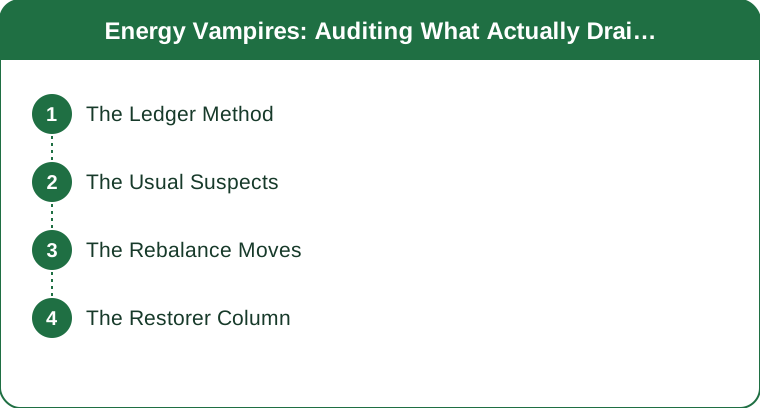
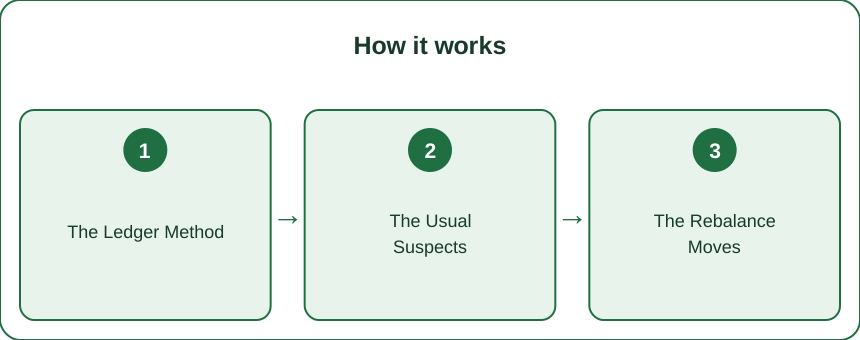
Run a ledger for one week. It takes about fifteen seconds per entry.
The method:
After each meaningful block of your day — a meeting, a task, a conversation, a commute — write down the block and one word: energized, neutral, or drained. Phone notes, a paper notebook, whatever you’ll actually use.
The rules that make it work:
- No analysis during the week. You’re collecting data, not diagnosing. The moment you start theorising mid-week you begin recording what you expect rather than what happened.
- Rate it immediately, within a few minutes. Retrospective ratings at the end of the day get flattened by whatever mood you’re in at 9pm.
- Include everything, including the small stuff. The five-minute things are frequently the culprits.
- Be honest about people. This is the uncomfortable part and also the most informative.
By Friday, the pattern confesses. And the thing that surprises almost everyone: it’s rarely the busy days that wreck you. Packed days full of work you find engaging often rate as neutral or energized. It’s the specific recurring line items — often only three or four of them — that account for most of the drain.
What Are the Most Common Energy Vampires?
They cluster into four types.
1. Meetings that should have been emails. The energetic cost isn’t the 30 minutes; it’s the fragmentation. A meeting at 11am destroys the entire block from 10 to 12 for anything requiring sustained focus.
2. Decision-heavy trivia. What’s for dinner. What to wear. Which of four essentially identical options to approve. These cost far more than their content warrants because decision-making draws on the same limited resource whether the decision matters or not — and “what’s for dinner,” asked daily, forever, is the reigning champion of this category.
3. Notification whiplash. Not the individual interruption, but the accumulated cost of never being more than four minutes from a switch. Research on task-switching consistently finds it more expensive than people estimate.
4. Certain people. This is the awkward one. Conversational one-way streets, the colleague who processes every problem out loud at you, the friend whose catch-ups are exclusively downloads. The audit names names privately; what you do about it can stay diplomatic.
A fifth that’s less obvious: anticipatory dread. A difficult thing scheduled for Thursday drains Monday through Wednesday too. That drain is invisible in a calendar and extremely visible in a ledger.

What Do You Do About the Drains You Can’t Delete?
Most of them can’t be deleted. Four moves that work on the ones that stay.
Batch them. One decision session beats five scattered ones. Meal-plan on Sunday instead of deciding at 6pm daily. Do all your admin in one 45-minute block rather than letting it leak through the week. Batching converts five small drains into one medium one.
Buffer after them. Never schedule deep work immediately after a known vampire. Put fifteen minutes of nothing after that meeting. This feels like waste and isn’t — the work you’d have scheduled there was going to be bad anyway.
Automate repeat decisions. Dinner rotations. Outfit defaults. Standard responses to recurring requests. Every decision you convert into a default is a small permanent refund.
Dose them. For drains that can’t be removed or batched — a difficult ongoing relationship, an unpleasant project — control exposure rather than trying to change the thing. Shorter meetings. A defined end time. A walk immediately afterward.
What Nobody Tells You About Energy Audits
The restorer column is worth more than the drain column. Everyone runs the audit hunting for vampires and then ignores the other half of the data — the things reliably marked energized. Usually it’s a small, specific list: a particular walk, one specific friend, a tidy kitchen, twenty minutes of a hobby, a certain type of work.
Schedule restorers like meetings, because the vampires already have that privilege. This is the single most useful thing that comes out of the exercise. Drains are almost always in your calendar with defenders; restorers are almost always in the leftover space, which means they’re first to go when the week gets tight.
Energy is a budget with income and expenditure, and most people only ever audit the spending. You just found both.
Some drains are worth paying for. A demanding project you care about might rate as drained and still be entirely worth it. The audit isn’t a list of things to eliminate; it’s a price list. Knowing what something costs lets you decide whether you want to buy it.
One week is enough for a first pass, and a repeat quarterly is worth it. Drains change. The thing that exhausted you in February may be fine by June, and something new will have appeared.
If the ledger comes back drained nearly everywhere, that’s a different signal. Persistent exhaustion across all domains — including things you used to enjoy — can indicate burnout, depression, or a physical cause like anaemia or a thyroid issue. That’s worth raising with a doctor rather than solving with better calendar management.
Frequently Asked Questions
How long should I run the energy ledger?
One full week including a weekend is the minimum for a useful picture, since weekday and weekend drains differ substantially. Two weeks gives you more confidence that a pattern is real rather than a one-off bad week. Running it much longer usually produces diminishing returns — you’ll have spotted the main culprits well before then.
What if the biggest drain is a person I can’t avoid?
Focus on dosing and buffering rather than elimination, since those are the levers you actually control. Shorten the exposure where you can (a walking meeting has a natural end; a coffee doesn’t), schedule nothing demanding immediately afterward, and pair the interaction with a known restorer where possible. If it’s a work relationship causing sustained strain, it may be worth raising with a manager or HR.
Isn’t this just going to make me more self-conscious about my day?
For the first day or two, slightly — most people find the awareness settles quickly and the entries become almost automatic. It’s a temporary cost against a fairly durable benefit. If tracking makes you anxious rather than curious, stop; the exercise isn’t worth doing at the price of rumination.
TL;DR:
- Log every block for one week with one word: energized / neutral / drained. No analysis until Friday
- It’s rarely the busy days — it’s three or four specific recurring line items
- Usual suspects: meetings-that-should-be-emails, decision trivia, notification whiplash, certain people
- Fixes: batch the drainers, buffer after them, automate repeat decisions, dose what’s left
- The restorer column matters more — schedule those with the same seriousness as meetings
- Some drains are worth paying for. The audit is a price list, not a hit list
- Drained everywhere is a different signal — worth a conversation with a doctor
Tiredness was never a math error. It was unaudited accounting, and the books just opened.
Keep Reading
This article is for general informational purposes only and is not medical advice. Always consult a qualified health professional for guidance specific to you.