The Complete Guide to Energy Crashes by Time of Day — and What Each One Actually Means
Quick Answer: The timing of an energy crash is a genuine diagnostic clue — a mid-morning crash usually points to breakfast composition, an early-afternoon crash to post-lunch blood sugar swings, and a late-afternoon or evening crash to accumulated sleep debt or circadian dip. Matching the fix to the timing works better than a generic energy fix applied to all three.
Most energy advice treats “low energy” as one problem with one set of fixes. In practice, a crash at 10am, one at 2pm, and one at 7pm are usually caused by different things entirely, and figuring out which is which is most of the battle.

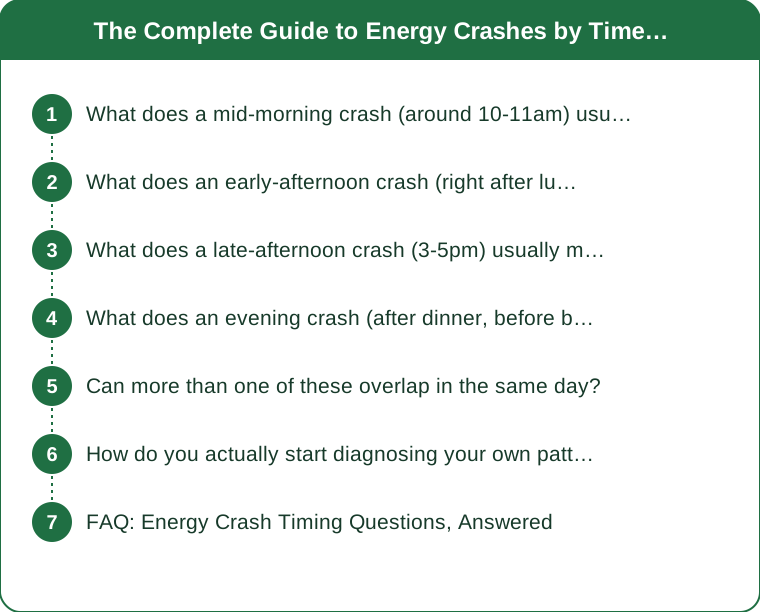
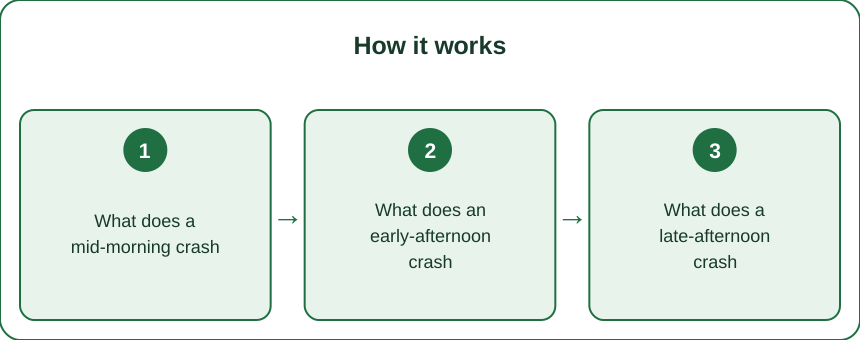
What does a mid-morning crash (around 10-11am) usually mean?
This timing lines up most closely with breakfast composition — a high-carbohydrate, low-protein breakfast produces a blood sugar spike followed by a crash roughly 2-3 hours later, which lands right around mid-morning for a typical breakfast time.
Fix: Add 20-25g of protein to breakfast and see if the crash shifts later or disappears — this single change resolves a large share of mid-morning crashes without touching anything else in the day.
What does an early-afternoon crash (right after lunch) usually mean?
A crash landing within an hour of lunch is the classic post-meal blood sugar swing pattern, especially after a carb-heavy lunch eaten alone without much protein or fiber to slow the glucose absorption.
Fix: Restructure lunch around protein and fiber first, carbs second — same total calories, different order and ratio, often meaningfully smooths out the post-lunch dip.
What does a late-afternoon crash (3-5pm) usually mean?
This window overlaps with a natural circadian dip most people experience regardless of what they ate, compounded by whatever sleep debt has built up over the week — it’s less about a specific meal and more about accumulated rest deficit and a biological low point.
Fix: A short walk or brief bright-light exposure works better here than more food, since the cause is more circadian and sleep-related than blood-sugar related.

What does an evening crash (after dinner, before bed) usually mean?
An evening crash is often the accumulated total of the day’s sleep debt and stress catching up, rather than anything about dinner specifically — by evening, whatever deficit built up during the day tends to surface as the day’s momentum runs out.
Fix: This one isn’t solvable same-day — it’s a signal to actually address sleep quantity or quality that night and over the following several days, not a same-day energy fix.
Can more than one of these overlap in the same day?
Yes — a bad breakfast plus a bad lunch plus poor sleep can produce crashes at all three points in the same day, which is why isolating and fixing one at a time (starting with breakfast, since it’s usually the easiest lever) is more manageable than trying to overhaul the whole day at once.
How do you actually start diagnosing your own pattern?
Track crash timing for one week without changing anything yet, noting roughly when energy dips hit relative to meals and sleep the night before. A consistent time-of-day pattern across several days is a much stronger signal than any single day’s experience.
FAQ: Energy Crash Timing Questions, Answered
Why do I crash at the exact same time almost every day?
A consistent daily timing pattern usually points to a repeating cause — most often breakfast or lunch composition, or an accumulated sleep debt hitting the same circadian low point daily.
Can poor sleep cause a crash at any time of day, not just the evening?
Yes — accumulated sleep debt can worsen crashes at any time point, compounding whatever meal-related dip is already happening.
Should I treat a mid-morning and late-afternoon crash the same way?
No — they usually have different primary causes (breakfast composition versus circadian dip and sleep debt), so the same fix rarely works equally well for both.
TL;DR:
- Mid-morning crashes usually trace back to breakfast carb-to-protein ratio
- Early-afternoon crashes usually trace back to lunch’s blood sugar impact
- Late-afternoon and evening crashes lean more on circadian dip and accumulated sleep debt
- Tracking crash timing for a week reveals the pattern better than judging from a single day
The timing of the crash is data, not just an inconvenience — matching the fix to when it happens works better than one generic energy fix applied everywhere.
Keep Reading
This article is for general informational purposes only and is not medical advice. Always consult a qualified health professional for guidance specific to you.