The Complete Guide to Your Energy When the September Schedule Lands
Quick Answer: A September schedule shift drains you because three separate systems get moved at once - your sleep timing, your meal timing, and your light exposure - and each one takes days to weeks to re-anchor. The fix is to move them in order rather than all at once: fix light exposure first (fifteen minutes outdoors within an hour of waking), then meal timing, then bedtime. Expect roughly one day of adjustment per hour of shift, and stop blaming your sleep quantity for a timing problem.
You are sleeping the same seven hours. You are eating roughly the same food. You are, if anything, moving slightly more than you did in August.
And you are running on empty by 2pm in a way you were not two weeks ago. Here is what actually moved.

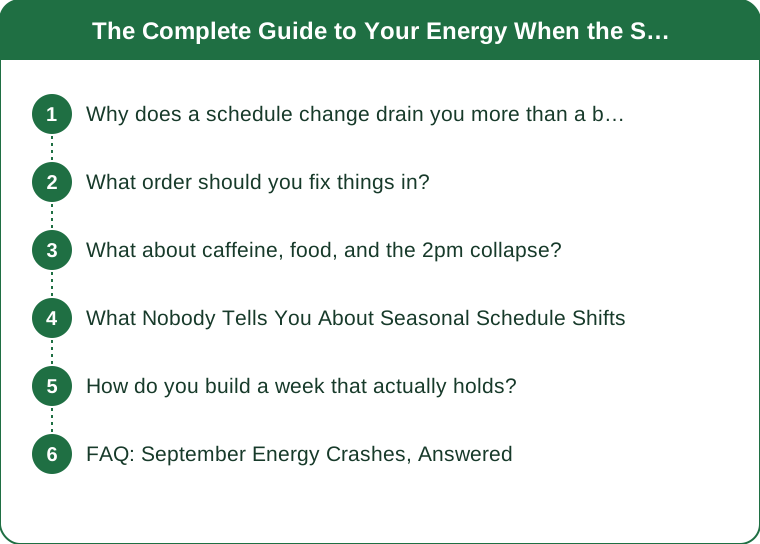
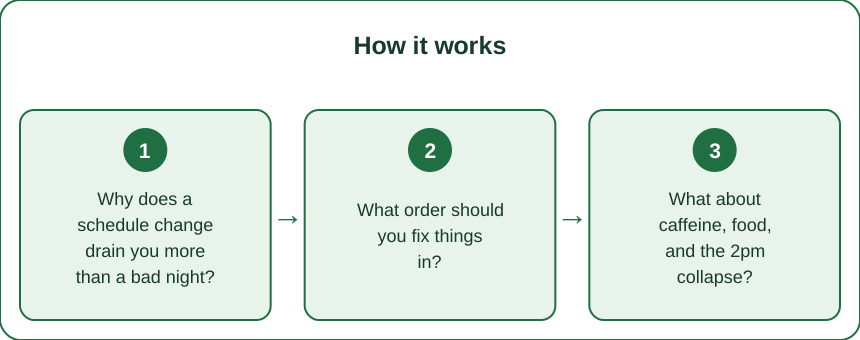
Why does a schedule change drain you more than a bad night?
Because you moved three clocks, not one. Sleep timing, meal timing, and light exposure each drive their own set of circadian signals, and a September restart typically shifts all three within the same 48 hours. A single bad night moves nothing structurally; a schedule change moves everything at once and then asks your body to perform on day one.
Your internal clock does not renegotiate quickly. Circadian rhythm shifts happen at a rate roughly comparable to jet lag adaptation - on the order of a day per hour of change, sometimes longer for phase advances, which is what an earlier wake time is. Moving from a 7:30am wake to a 6am wake is a 90-minute phase advance, and expecting that to feel normal after two days is expecting more than the system delivers.
Phase advances are harder than phase delays. Staying up later is easier than getting up earlier, which is why the end of a holiday hurts more than the start of one. Your body drifts naturally toward later, so an earlier start is working against the grain.
Melatonin timing lags behind your alarm. Your alarm clock changed instantly. The hormonal signals that tell you to feel alert changed on their own schedule, which means you are waking during a window where your body is still running a night-time programme.
Core body temperature follows the same lag. Alertness tracks the daily temperature rhythm closely, and that rhythm does not jump because your calendar did. Early in a shift you are asking for peak performance during your physiological trough.
Sleep pressure gets scrambled too. If you are waking earlier but not yet falling asleep earlier, you accumulate a real sleep debt on top of the timing problem, and the two compound rather than adding.
And the cognitive load is genuinely higher. New routes, new times, new logistics, and dozens of small decisions that were automatic in August are all consuming attention that used to be free. That is real work, and it is invisible on any tracker.
What order should you fix things in?
Light exposure first, because it is the strongest lever. Morning light is the primary signal that sets circadian timing, and it works faster and more reliably than any bedtime adjustment. Get outdoors for ten to fifteen minutes within an hour of waking, without sunglasses, even on an overcast day - outdoor light on a grey morning is still many times brighter than indoor lighting.
Then meal timing, because it anchors peripheral clocks. Your liver, gut, and muscle tissue run their own clocks that respond primarily to when you eat. Eating breakfast at your new time, consistently, for a week does more for your afternoon energy than any specific food choice.
Then bedtime, and only after the first two are working. Trying to fall asleep 90 minutes earlier before your light and meal timing have moved is how people spend three weeks staring at a ceiling and concluding they have insomnia. Bedtime follows the other two rather than leading them.
Move in 15 to 20 minute increments, not in one jump. Shifting bedtime a quarter of an hour every two or three days works. Shifting it 90 minutes on a Sunday night does not, and the failure convinces people the whole project is impossible.
Hold the wake time absolutely constant, including weekends. The wake time is the anchor for everything else. A weekend lie-in of two hours re-creates the exact problem you spent the week solving, and this is the single most common reason a September adjustment drags into October.
Cut evening light exposure in the last hour. Bright overhead lighting and screens at close range delay melatonin onset, which is precisely the thing you are trying to move earlier. Dimming the room does more than any supplement.
And give it two to three weeks before judging. A 90-minute shift with good light discipline typically settles inside two weeks. Judging it on day four tells you nothing except that day four is hard.
What about caffeine, food, and the 2pm collapse?
Caffeine timing matters more than caffeine amount right now. Caffeine has a half-life of roughly five to six hours, so a 3pm coffee still has meaningful levels in your system at 9pm - exactly when you are trying to fall asleep 90 minutes earlier than usual. Set a hard cutoff eight hours before your new bedtime.
Do not increase your dose to cover the transition. It works for about four days and then you have a tolerance problem layered on top of a timing problem, and the underlying circadian shift has not progressed at all.
The afternoon dip is normal and is not the schedule’s fault. There is a genuine circadian dip in alertness in the early afternoon that exists regardless of what you ate. During a schedule shift it lands harder and sometimes earlier, but it is a feature of the system rather than evidence of a problem.
Protein and fibre at breakfast flatten the morning curve. A breakfast that is mostly refined carbohydrate produces a rise and fall that stacks directly onto an afternoon dip you were going to have anyway. Aim for 20 to 30 grams of protein at the first meal.
Lunch size drives afternoon severity. A very large lunch reliably deepens the post-meal dip. Moving some of that volume to a mid-afternoon snack often changes the afternoon entirely, and costs nothing.
Hydration is a small effect that people over-claim and then under-do. Mild dehydration measurably affects perceived fatigue and concentration. It will not fix a circadian shift, but being consistently under-hydrated makes every other symptom worse for no benefit.
And a ten-minute walk beats a second coffee at 2pm. Movement raises alertness immediately without borrowing from your evening, and it delivers light exposure as a second effect if you go outside.

What Nobody Tells You About Seasonal Schedule Shifts
The daylight is shrinking at the same time. In mid-August through September, daily light is dropping by roughly two to three minutes a day at mid-latitudes. You are trying to wake earlier while the morning is getting darker, which means the light cue you most need is arriving later each week. This compounding is the part almost nobody accounts for.
Your energy problem may be a decision-fatigue problem. A new routine requires dozens of conscious choices that used to be automatic. Batching decisions - laying out clothes, prepping breakfast, fixing a route - removes a genuine drain that no amount of sleep addresses.
Everyone else is also depleted, which distorts your comparison. September is a low point for a lot of people simultaneously, so the ambient mood you are measuring yourself against is not the July baseline you remember.
Exercise timing may need to move too, and later is not always worse. If your training moved to 6am and it feels terrible, that is partly because early morning is your physiological low point during a phase advance. Moving it to lunchtime for two weeks while the shift settles is a reasonable, temporary answer.
The first week back is the worst week, not the new normal. People make significant decisions - quitting a commitment, changing a job pattern, buying supplements - based on how week one feels, which is the least representative data available.
Weekend recovery sleep does not repay the debt cleanly. Some catch-up sleep helps, but a large weekend shift moves your clock backwards and makes Monday harder. A 30 to 60 minute lie-in is a reasonable compromise; three hours is self-sabotage.
And persistent exhaustion beyond a few weeks deserves a look elsewhere. Iron deficiency, thyroid issues, and sleep apnoea all present as unexplained fatigue and are all common. If the fatigue is not resolving with a settled schedule after three or four weeks, this is worth raising with a doctor. This is general information, not medical advice.
How do you build a week that actually holds?
Pick the wake time first and treat it as fixed. Everything else in the plan is negotiable; this is not. Choose the time your hardest weekday requires and apply it to all seven days for the first three weeks.
Attach morning light to something you already do. Drinking coffee on a doorstep, walking to a postbox, or taking a call outside all work. Light exposure that depends on remembering a new habit fails; light exposure attached to an existing one survives.
Anchor two meals, not three. Breakfast and dinner at consistent times give the peripheral clocks a stable signal. Lunch can float without much cost, which is useful because lunch is the meal most likely to be disrupted by a new schedule.
Schedule the week’s hardest cognitive work for mid-morning. For most people on a standard schedule, alertness peaks a few hours after waking and again in the early evening. Put the demanding work there and put administrative work in the 2pm trough rather than fighting it.
Build in one genuine buffer block. A 30-minute unallocated slot on the two busiest days absorbs the overruns that otherwise eat into the evening and push bedtime later, which is how a good plan collapses in week two.
Reduce training volume for the first ten days. Not zero - movement helps the adjustment - but a schedule shift is a real physiological stressor and stacking a training peak on top of it produces the fatigue people blame on the training.
And write down what time you actually fell asleep, not what time you went to bed. The gap between the two is the number that tells you whether your bedtime shift is working, and it is the number almost nobody tracks.
FAQ: September Energy Crashes, Answered
Why am I so tired when the school year starts even though I sleep the same amount?
Because the problem is timing, not quantity. Your sleep window, meal window, and light exposure all moved at once, and the internal clock that governs alertness shifts at roughly a day per hour of change rather than instantly.
How long does it take to adjust to waking up earlier?
Roughly one day per hour of shift as a rule of thumb, so a 90-minute earlier start typically takes one to two weeks with good morning light exposure, and considerably longer without it.
What is the fastest way to reset my body clock?
Morning outdoor light within an hour of waking, held consistently, plus a fixed wake time seven days a week. Light is the strongest and fastest circadian signal available and it costs nothing.
Should I nap during the transition?
A short nap of 10 to 20 minutes before mid-afternoon can help without hurting your night. Longer or later naps reduce the sleep pressure you need to fall asleep at your new earlier bedtime.
When should I see a doctor about tiredness?
If fatigue persists beyond three to four weeks of a settled schedule, or comes with breathlessness, unusual heaviness, or daytime sleepiness despite adequate sleep, it is worth investigating iron, thyroid, and sleep quality. This is general information, not medical advice.
TL;DR:
- A September schedule shift moves three clocks at once - sleep timing, meal timing, and light exposure - and each takes days to weeks to re-anchor.
- Fix them in order: morning outdoor light first, meal timing second, bedtime last. Bedtime follows the other two rather than leading.
- Hold your wake time fixed all seven days, and move bedtime in 15 to 20 minute steps rather than one jump.
- Expect roughly a day of adjustment per hour of shift, and do not judge the plan on week one.
- Set a caffeine cutoff eight hours before the new bedtime, and take a walk rather than a second coffee at 2pm.
- Persistent fatigue after three or four settled weeks is worth investigating medically rather than scheduling around.
You did not get worse at mornings over the summer. You moved three clocks in one weekend and asked them to arrive on time.
This is general information, not medical advice.
Keep Reading
This article is for general informational purposes only and is not medical advice. Always consult a qualified health professional for guidance specific to you.