The Complete Guide to the Energy Drains in Your Environment You Never Notice
Quick Answer: If you are tired in a way that sleep and food do not fix, the room may be the problem. Indoor CO2 above 1,000ppm measurably reduces cognitive performance, low-frequency background noise keeps the stress response mildly active, and flickering or dim lighting forces continuous visual effort. These drains are individually small and additive — fixing three of them usually produces a change you can feel within a day.
There is a specific kind of tiredness that does not respond to any of the usual fixes. You slept enough. You ate. You are not overtrained. And by 2pm you feel like you are pushing through something.
Most energy advice looks at inputs — sleep, food, training, stress. It rarely looks at the room you are sitting in, which you occupy for eight to ten hours a day and which is quietly charging you for the privilege.

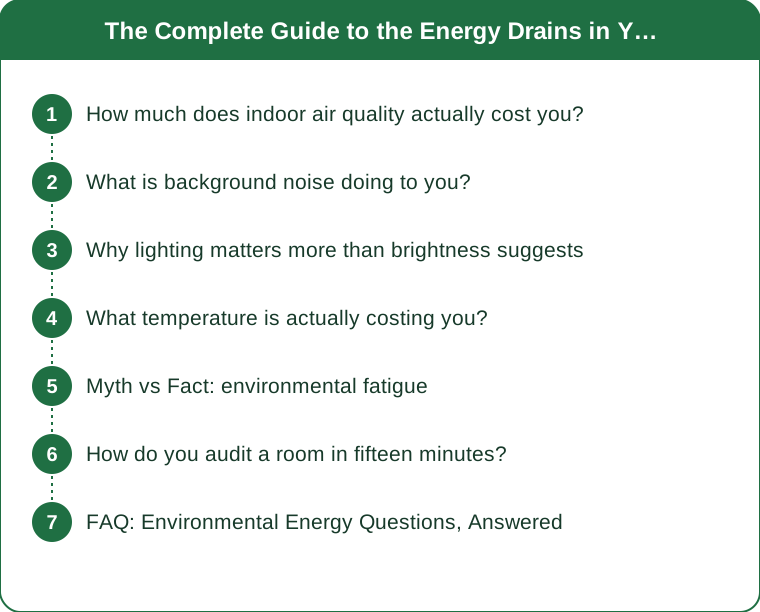
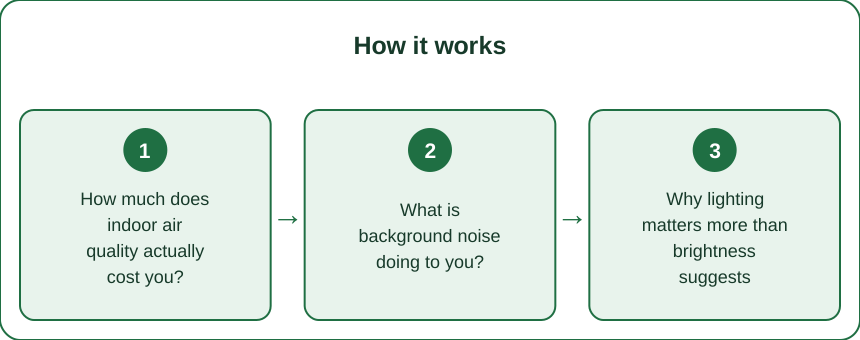
How much does indoor air quality actually cost you?
More than almost anyone estimates, and it is the most measurable item on this list.
Outdoor air sits at roughly 420ppm of CO2. A closed bedroom with one sleeping adult typically reaches 1,200 to 2,000ppm by morning. A closed meeting room with several people can pass 2,500ppm within an hour.
Controlled studies on cognitive function have found meaningful declines beginning around 1,000ppm, with larger drops in decision-making, strategic thinking and information usage by 1,400ppm. These are not subtle effect sizes in the research, and crucially the participants generally did not report feeling impaired. That is the important part: the subjective sensation lags the actual decline. You feel slightly foggy long after your performance has dropped.
The symptoms people describe are consistent — a heavy head, difficulty holding a thought, rereading the same paragraph, and a specific desire to yawn that has nothing to do with sleepiness.
Humidity compounds it. Below 30 percent relative humidity, mucous membranes dry out, eyes get scratchy, and the low-grade discomfort itself consumes attention. Above 60 percent, the body’s evaporative cooling becomes less efficient and everything feels heavier.
The fix is almost comically simple and almost nobody does it consistently: open a window for five to ten minutes, twice a day, fully. Cross-ventilation with two openings clears a room several times faster than one. A cheap CO2 monitor — around $60 to $100 — turns this from a theory into a visible number, and most people who buy one change their habits within a week purely because they can see it.
As the weather turns over the next few weeks and windows start staying shut, this becomes the single largest seasonal energy drain in most homes.
What is background noise doing to you?
Operating a low-level stress response you never consciously register.
The distinction that matters is between noise you notice and noise you have habituated to. Habituation means you stop reporting the sound. It does not mean your nervous system stops processing it. Studies of chronic low-level noise exposure — traffic, ventilation hum, office machinery — find elevated cortisol and reduced performance on sustained attention tasks in people who describe the environment as quiet.
Low-frequency noise is the worst offender and the least noticed. A refrigerator compressor, a fan, road hum through a wall, and building ventilation all sit in a range that is hard to consciously localise and hard to block. Standard foam and soft furnishings absorb high frequencies well and low frequencies badly, which is why a carpeted room can still feel exhausting.
Intermittent noise costs more than constant noise. A predictable hum can be adapted to. A door that slams unpredictably, a phone that buzzes at intervals, or conversation that starts and stops repeatedly triggers an orienting response each time — a small involuntary redirection of attention with a real recovery cost. This is why open offices measure badly even at modest decibel levels.
Practical interventions, in order of effect per effort:
Identify the constant sources by standing still in the room for sixty seconds with your eyes closed. Most people find two or three they had genuinely stopped hearing.
Move the desk away from the shared wall or the appliance. Distance is more effective than absorption for low frequencies.
Use broadband masking — a fan, brown noise, or rain — rather than music when the noise is intermittent. Masking removes the startle component. Music with lyrics adds a language-processing load and is a poor choice for focused work.
And if you use noise-cancelling headphones, notice that they are excellent on constant low frequencies and much weaker on speech, which is the opposite of what most people assume.
Why lighting matters more than brightness suggests
Because your visual system does continuous, effortful correction that you never see the bill for.
Three separate lighting problems drain energy, and they have different fixes.
Insufficient light for the task. Reading or detailed work under low light forces the eye to work harder to resolve edges, and the ciliary muscle holds a sustained contraction. The result is a headache behind the eyes and a specific end-of-day fatigue. Desk work generally wants 300 to 500 lux at the surface; most home rooms are lit at 100 to 150 lux. A single task lamp fixes this for under $40, and the difference is often noticeable the same evening.
Contrast mismatch. A bright screen in a dark room is the worst common case. The pupil constantly adjusts between the bright screen and the dark surroundings, and that adjustment has a metabolic cost. Bias lighting — a lamp behind or beside the screen bringing the background closer to screen brightness — is the fix, and it is why people report less eye strain from the same screen time simply by adding a lamp behind the monitor.
Flicker. This is the one nobody suspects. Cheap LED bulbs and drivers can flicker at rates too fast to consciously see and slow enough for the visual system to process, and this is associated with headaches and eye fatigue in sensitive people. The test costs nothing: point a phone camera at the bulb and look for banding on the screen. If you see rolling bands, that bulb flickers. Replacing the two or three bulbs in the rooms you spend the most time in is a genuinely underrated intervention.
Timing is the fourth lever. Bright light early stabilises circadian rhythm and improves next-night sleep; bright overhead light late does the opposite. Getting real daylight within the first hour of waking is more effective for daytime alertness than any lamp — and it gets harder to do as sunrise moves later through September, which is a large part of why energy dips as autumn starts.

What temperature is actually costing you?
Thermal regulation is metabolically expensive, and the cost is largest in the range people describe as fine.
Office performance studies broadly find a peak somewhere around 21 to 23°C for cognitive tasks, with measurable declines on either side. The interesting finding is not the peak, it is the asymmetry: being slightly too warm is more damaging to cognitive performance than being slightly too cool. Warmth produces drowsiness, reduced vigilance and a strong pull towards low-effort behaviour. Cool produces discomfort, which is unpleasant but tends to preserve alertness.
This has a direct practical consequence for the end of summer. A room that has been holding heat all day sits at 25 or 26°C in the late afternoon — exactly the window where most people report their worst slump. It is very easy to attribute that entirely to lunch and blood sugar when a meaningful part of it is the room.
Local versus ambient matters. Cooling your hands, face or neck produces a disproportionate subjective improvement relative to the energy cost, because those areas carry a high density of thermoreceptors. A fan on your face at a warm desk buys more alertness than lowering the whole room by a degree, and costs almost nothing.
Sleep temperature is a separate and larger issue. Core temperature must fall to initiate sleep, so a bedroom at 16 to 19°C supports sleep onset while a bedroom at 24°C fights it. If your energy has been poor across a hot fortnight, bedroom temperature is likely the mechanism, and it resolves on its own as nights cool.
Humidity interacts with all of this. At high humidity, sweat evaporates poorly and 24°C feels like 27°C. At low humidity in a heated room later in the year, the same 21°C feels cold and dry. The comfortable band is narrower than the thermostat suggests.
Myth vs Fact: environmental fatigue
Myth: If the room were a problem, I would notice. Fact: This is the central finding of the CO2 research and it holds across most environmental factors. Habituation removes the conscious signal while leaving the physiological cost. The whole category is defined by being unnoticed — that is why it goes unfixed.
Myth: Plants meaningfully clean indoor air. Fact: The famous NASA study used sealed chambers, and replicating that effect in a real room would require something in the region of a plant per square foot. Plants are good for mood and for the sense of a space being cared for. They are not an air-quality intervention. Opening a window for five minutes outperforms an entire room of houseplants.
Myth: Air purifiers fix stuffiness. Fact: HEPA purifiers remove particulates — dust, pollen, smoke — and do nothing at all about CO2. If a room feels stuffy and heavy, a purifier will not help; ventilation will. If a room makes you sneeze, a purifier will help a great deal. They solve different problems and are routinely bought for the wrong one.
Myth: You get used to a noisy or badly lit environment. Fact: You get used to reporting it as normal. Performance measures do not show the same adaptation. This is well documented for noise and reasonably supported for lighting.
Myth: These effects are too small to matter. Fact: Individually, yes. The point is that they are simultaneous and additive. A stuffy, warm, dimly lit room with a ventilation hum is not one small effect, it is four running at once for eight hours — and that is a large fraction of the gap between a good day and a bad one.
How do you audit a room in fifteen minutes?
Do this once, in the room where you spend the most waking hours. It is not a project.
Minute 1 to 2: air. When was the window last fully open? If the answer is more than a day, open it now and note whether the room feels different in ten minutes. That single observation tells you most of what you need. If you want a number, a CO2 monitor is the highest-value purchase in this entire guide.
Minute 3 to 4: sound. Stand still, eyes closed, sixty seconds. Write down every sound source you can identify. The ones that surprise you are the ones you had habituated to.
Minute 5 to 7: light. Is there enough light on the actual work surface, or just in the room? Is the screen much brighter than its surroundings? Point your phone camera at each bulb and check for flicker banding.
Minute 8 to 9: temperature. Check the actual reading rather than your impression, and check it at the time of day you feel worst rather than now. Most people are surprised by the late-afternoon number.
Minute 10 to 12: visual load. Everything in your visual field is being processed at some level. A cluttered desk and a wall of open browser tabs both consume a small, continuous amount of attention. Clearing the physical field is quick and the effect on how a room feels is out of proportion to the effort.
Minute 13 to 15: pick two. Not all of them. The two that were most obviously wrong, fixed properly, will tell you within a couple of days whether this category matters for you. Fixing everything at once tells you nothing about what worked.
The most common two, by a wide margin: ventilation and task lighting. Both are cheap, both are fast, and both are routinely dismissed as too simple to be the answer.
FAQ: Environmental Energy Questions, Answered
How fast should I expect to notice a difference?
Ventilation is immediate — ten to fifteen minutes after opening a window, in the same session. Lighting is same-day for eye strain and about a week for the sleep-related benefits of morning light. Noise changes take a few days, because habituation has to unwind.
Is a CO2 monitor worth buying?
If you work from home, probably yes. The value is not the data, it is that an invisible problem becomes visible, and visible problems get fixed. Look for one with a true NDIR sensor rather than an estimated reading; the cheapest devices infer CO2 from other variables and are close to useless.
What about air quality in the other direction — outdoor pollution?
Worth checking before opening windows in a high-pollution area or during wildfire smoke. On those days, run a HEPA purifier and ventilate briefly rather than continuously. For most people on most days, outdoor air is dramatically better than indoor air and the trade is easy.
Could this be why I feel better outdoors?
Partly, and it is a reasonable diagnostic. If a twenty-minute walk reliably resets your afternoon, some of that is movement and daylight, and some of it is simply leaving the room. If the reset happens before you have walked far, the room is a strong suspect.
When is tiredness not environmental?
If it persists in different rooms, on holiday, and after a genuinely good week of sleep, it is not the environment. Persistent unexplained fatigue, particularly with other symptoms, deserves a proper medical assessment — thyroid, iron and B12 are common, checkable causes.
This is general information, not medical advice.
TL;DR:
- Environmental drains are individually small, simultaneous and unnoticed — that combination is what makes them matter.
- CO2 above 1,000ppm measurably reduces cognition before you feel it. Open a window twice a day.
- Slightly too warm costs more than slightly too cool; 21 to 23°C for work, 16 to 19°C for sleep.
- Check bulbs for flicker with a phone camera, add a task lamp, and add bias light behind the screen.
- Audit once, fix two things, and judge from there.
The reason this category stays unfixed is that none of it feels like a real explanation. Nobody wants the answer to their fatigue to be a window. It frequently is.
Keep Reading
This article is for general informational purposes only and is not medical advice. Always consult a qualified health professional for guidance specific to you.