The Complete Guide to Fixing Your Energy Through the Late Summer Transition
Quick Answer: The late-August energy dip is mostly a light-timing problem. Sunrise is moving later by about a minute a day, which delays your circadian signal while your alarm stays fixed, producing a widening gap between body clock and schedule. Add accumulated summer sleep debt, the end of long evenings, and a return to structured schedules, and most people feel it within the same two-week window. Morning light exposure is the single highest-leverage fix.
This is the long version — the mechanisms, the daily structure, the things that do not work, and how to tell when it is something else.

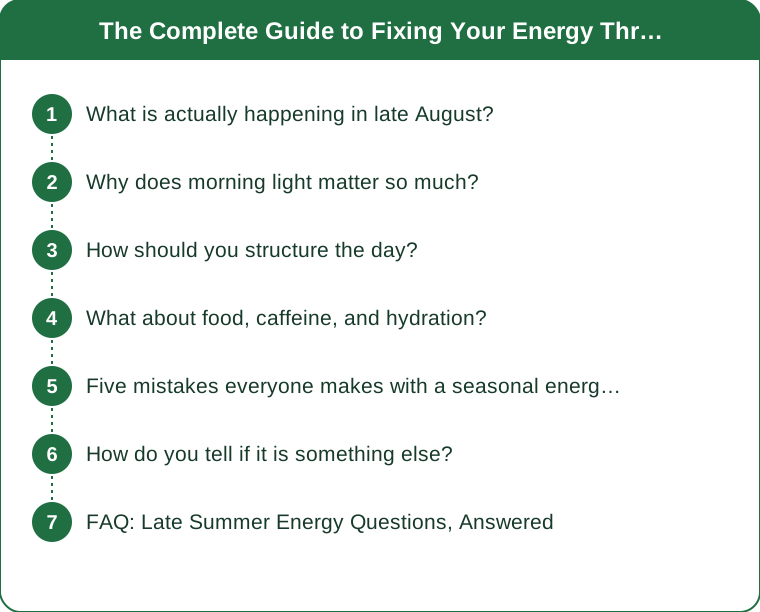
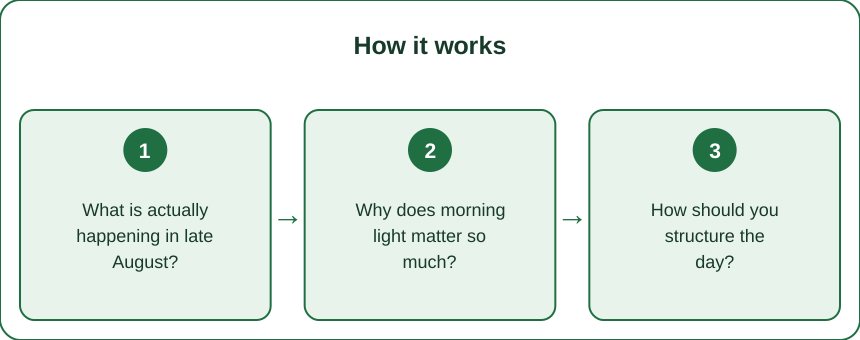
What is actually happening in late August?
Four processes converging, which is why the effect feels larger than any single cause would suggest.
Daylight is shrinking faster than at any other point in the year. Around the equinoxes, the rate of change in day length peaks. In late August and September, most of the northern US loses two to three minutes of daylight per day — roughly fifteen to twenty minutes a week. This is faster than the shortening in November, and it is happening while the weather is still warm enough that nobody attributes tiredness to the season.
Sunrise moves later while your alarm does not. This is the mechanism that matters most. Your circadian system takes its primary timing cue from morning light. As sunrise drifts later, the light signal that used to arrive before your alarm now arrives after it, and eventually you are waking in near-darkness. The body clock drifts later; the schedule does not. The result is a widening mismatch that feels exactly like tiredness, because functionally it is — you are waking during a phase your body still considers night.
Summer sleep debt comes due. Long evenings, late sunsets, holidays, social schedules, and warm nights that disrupt sleep all accumulate through July and August. Sleep debt does not present as dramatic exhaustion; it presents as a gradually lower baseline that you stop noticing until something makes it visible.
Schedules restructure. School terms restart, work rhythms resume after summer, and the loose August pattern gives way to something more demanding. The cognitive load rises at exactly the point the physiological baseline is lowest.
None of these are pathological. All of them are predictable, which means all of them are addressable.
Why does morning light matter so much?
Because it is the strongest single input to the system that governs when you feel alert, and it is enormously more powerful than people assume.
Light sets the clock through a dedicated pathway. Specialised cells in the retina — separate from the ones you see with — detect light and signal directly to the brain’s master clock. This pathway is most sensitive to bright light in the first hours after waking, and it is the mechanism that anchors your entire twenty-four-hour rhythm.
The intensity difference is enormous and completely invisible. A well-lit indoor room is around 300-500 lux. An overcast morning outdoors is around 10,000 lux. Direct sun is 50,000-100,000 lux. Your visual system adapts so smoothly that indoors and outdoors feel similarly bright, while the actual signal differs by a factor of twenty to two hundred. Sitting by a window is not equivalent to going outside, and this single misunderstanding is why most people believe they already get enough light.
Timing matters as much as intensity. Light in the first hour or two after waking advances the clock, making you sleepier earlier that night and more alert earlier the next morning. Light late in the evening does the opposite. So the same lamp is helpful at 7am and counterproductive at 10pm.
The practical prescription: ten to twenty minutes outdoors within an hour of waking, on most days. No sunglasses for that period, though never look directly at the sun. On overcast days, extend it toward thirty minutes — 10,000 lux under cloud is still vastly more than any indoor lighting.
Why it works specifically for this problem: you are counteracting a drifting light signal with a deliberate one. As natural sunrise moves later, going outside at a fixed time keeps the clock anchored where your schedule needs it.
How should you structure the day?
A full-day framework, because energy is a rhythm rather than a resource you spend down.
On waking: get outside within the first hour, for ten to twenty minutes. Walk, drink coffee outside, take the dog, stand on a balcony. This is the highest-leverage twenty minutes of the day.
Delay caffeine slightly. Adenosine — the molecule that builds sleep pressure — is still clearing in the first ninety minutes after waking. Caffeine taken immediately blocks receptors that were about to clear anyway, and it can push the afternoon crash later and harder. Waiting sixty to ninety minutes produces a smoother curve for most people, though this is genuinely individual and not worth forcing if it does not suit you.
Front-load demanding work. Alertness for most people peaks somewhere in the mid-to-late morning. Cognitively demanding work belongs there, and the meeting that could have been an email belongs in the afternoon dip.
Expect the early-afternoon dip and plan around it. It is a genuine circadian feature, not a failure. It arrives whether or not you eat lunch. A ten-minute walk outdoors is the most effective intervention available — you get light, movement, and a change of environment simultaneously.
Move in the late afternoon. Body temperature and physical performance peak in the late afternoon and early evening, which makes it the best time for training for most people. Exercise also strengthens the amplitude of the circadian rhythm, which improves both alertness during the day and sleep quality at night.
Dim the evening. From about two hours before bed, reduce overhead lighting and screen brightness. This matters more as the season progresses, because the natural evening dimming that used to happen at 9pm now happens at 8pm and will happen at 7pm.
Keep the wake time fixed. More important than the bedtime. A consistent wake time anchors the whole system, and a variable one leaves it permanently trying to resynchronise.

What about food, caffeine, and hydration?
Real contributors, though smaller than light and sleep, and worth getting right because they are easy.
Meal size drives the post-meal dip more than meal content. A large lunch produces a substantially bigger dip than the same food in a smaller portion. If your afternoon is unusable, halving lunch and adding a mid-afternoon snack usually resolves more than any specific dietary change.
Protein at breakfast helps more than most people expect. A breakfast of 25-30g protein produces steadier morning energy than a carbohydrate-dominant one, largely by flattening the blood glucose curve. This is one of the more reliably reported changes people notice.
Caffeine’s half-life is around five to six hours. A 3pm coffee still has roughly a quarter of its caffeine active at midnight. If sleep quality is part of the problem, a caffeine curfew around 2pm is a bigger lever than anything you add.
Dehydration is a genuine and underrated contributor in late summer. Mild dehydration measurably impairs concentration and mood, and it is easy to accumulate in warm weather while assuming you are drinking enough. It is also the easiest thing on this entire list to fix.
Alcohol fragments sleep even in small amounts. It shortens sleep latency and then disrupts the second half of the night. A drink with dinner is not neutral for next-day energy, and late-summer social schedules make this a bigger factor in August than in most months.
Iron, vitamin D, thyroid function, and B12 are the common medical causes of persistent fatigue, and none of them are diagnosable from a blog. If tiredness is severe, persistent for more than a few weeks despite good sleep and light habits, or accompanied by other symptoms, get bloods done. This is general information, not medical advice.
Five mistakes everyone makes with a seasonal energy dip
1. Sleeping in on weekends to catch up. Sleeping two hours later on Saturday and Sunday shifts your body clock later, and Monday morning feels like jet lag because functionally it is. Keeping the wake time within about an hour of the weekday time does more for Monday than the extra sleep did for Sunday. If you need recovery sleep, take it as an early night rather than a late morning.
2. Adding caffeine rather than adding light. More coffee treats the symptom and worsens the cause by degrading sleep quality. The comparison is not close: twenty minutes of morning daylight outperforms an extra coffee for afternoon alertness, and it improves that night’s sleep rather than damaging it.
3. Assuming it is psychological. The seasonal dip has documented physiological mechanisms. Treating a light-timing problem as a motivation problem produces guilt and no improvement, which is the worst available combination.
4. Waiting until it gets properly dark to act. Most people start thinking about seasonal energy in November, by which point the drift has been accumulating for three months. Late August is the correct moment to intervene, precisely because nothing looks wrong yet.
5. Changing five things at once. Doing all of the above simultaneously means you learn nothing about which one mattered for you, and it is unsustainable. Morning light for two weeks, alone, is the correct first experiment — it has the strongest evidence and the lowest cost.
The fourth one is the one that actually determines how the autumn goes.
How do you tell if it is something else?
Worth knowing where the line is, because seasonal tiredness and clinical fatigue can feel similar and are managed completely differently.
The seasonal pattern looks like this: tiredness concentrated in the morning and the early afternoon, improving noticeably with light exposure and movement, better on days you got outside, and better after a good night’s sleep. It responds to behavioural change within one to two weeks.
Signals that point elsewhere: fatigue that does not improve with adequate sleep; tiredness accompanied by breathlessness, dizziness, or a racing heart; unexplained weight change; persistent low mood, loss of interest, or hopelessness lasting more than two weeks; new pain; disrupted sleep that has no obvious cause; or fatigue severe enough to interfere with normal function.
Common medical contributors worth ruling out: iron deficiency, which is particularly common in menstruating women and produces exactly this presentation; thyroid dysfunction; vitamin D and B12 deficiency; sleep apnoea, which is substantially under-diagnosed and often presents as unrefreshing sleep rather than as obvious snoring; and depression, which very frequently presents primarily as fatigue rather than as sadness.
Seasonal affective patterns are also real and can begin in late summer for some people, well before the classic winter timing. If low mood accompanies the tiredness and follows an annual pattern, that is worth raising specifically with a clinician rather than managing alone.
The practical rule: give the light and sleep interventions two to three genuine weeks. If nothing has shifted, that is useful diagnostic information and a reason to see someone rather than to try harder. This is general information, not medical advice, and persistent fatigue deserves a proper assessment.
FAQ: Late Summer Energy Questions, Answered
Does a light therapy lamp work as a substitute for going outside?
Yes, and it is well evidenced — a 10,000 lux lamp used for twenty to thirty minutes in the morning is a genuine intervention. Outdoor light is still better where it is available, because it is brighter, involves movement, and does not require you to sit still. The lamp comes into its own from October when going outside at 7am means going out into the dark.
Why do I feel worse in late August than in December?
Partly the rate of change — daylight is shrinking fastest now — and partly that nothing external explains it yet. In December, the tiredness has an obvious cause and you have adapted your expectations. In August, the days are still warm and long enough that the drift is invisible, so the effect arrives without a story attached.
Is a nap a good idea?
A twenty-minute nap before about 3pm is genuinely restorative and does not typically affect night sleep. Longer naps take you into deeper sleep stages and produce grogginess, and naps after mid-afternoon reduce the sleep pressure you need that night. Twenty minutes, early, is the version that works.
TL;DR:
- Late August loses two to three minutes of daylight a day, so sunrise drifts later while your alarm stays fixed — that mismatch is most of the problem.
- Outdoor morning light is 20-200x brighter than indoors; ten to twenty minutes within an hour of waking is the single highest-leverage fix.
- Front-load demanding work, expect the early-afternoon dip, walk outside during it, and dim the evening from two hours before bed.
- Keep the wake time fixed — weekend lie-ins shift the clock later and cause Monday jet lag.
- Watch meal size more than meal content, set a 2pm caffeine curfew, and take dehydration seriously in warm weather.
- Change one thing for two weeks — morning light — rather than five at once.
- If two to three weeks of good light and sleep habits change nothing, that is a reason to get bloods done rather than to try harder.
Late August is the right moment to act precisely because nothing looks wrong yet. The people who feel fine in November are the ones who started now. This is general information, not medical advice.
Keep Reading
This article is for general informational purposes only and is not medical advice. Always consult a qualified health professional for guidance specific to you.