The Complete Guide to Recovering From One Bad Night of Sleep
Quick Answer: After one bad night you have lost alertness and emotional regulation, not fitness or metabolism. The three things that measurably help are morning light within 30 minutes of waking, caffeine timed to about 90 minutes after waking rather than immediately, and a normal bedtime tonight rather than an early one. A nap helps only if you keep it to 20 minutes or extend it to a full 90. What does not help is sleeping in on the following days to catch up.
One bad night is a completely different physiological event from chronic short sleep, and it deserves a different response. The research on acute sleep loss is unusually clear, and the practical upshot is encouraging: most of what you lose in a single night comes back after one normal night, provided you do not spend the day making it worse.

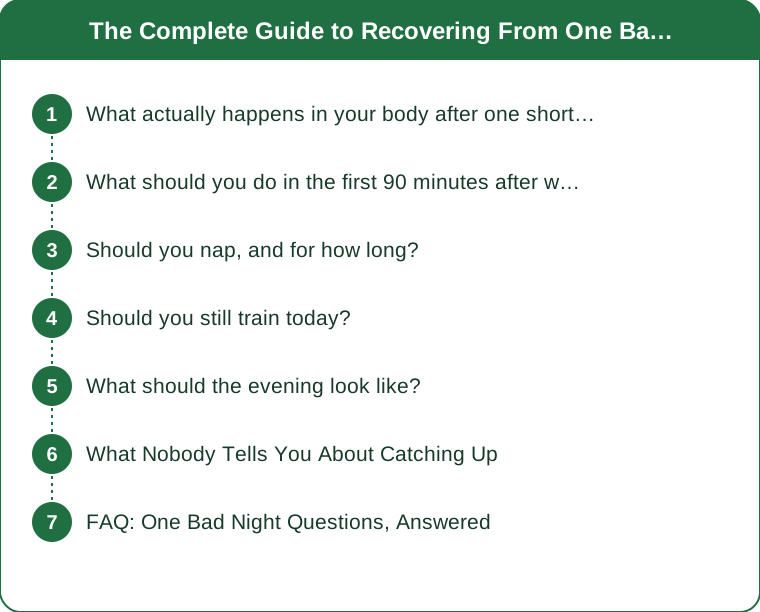
What actually happens in your body after one short night?
The losses are specific rather than general, which is why a targeted response works.
Attention degrades first and fastest. Sustained-attention performance drops measurably after a single night restricted to 4-5 hours. The failure mode is not feeling sleepy - it is brief lapses, missed details, and a marked slowdown in reaction time. People consistently rate their own performance as far better than it tests, and that gap is the genuinely risky part.
Emotional regulation takes a hit. Amygdala reactivity increases and the prefrontal brake on it weakens after acute sleep loss. In practice this means small irritations land harder and you are worse at deciding whether something is a big deal. If you find yourself furious about a parking space, that is a symptom, not a character flaw.
Appetite signalling shifts. Ghrelin rises and leptin falls after short sleep, and preference tilts toward higher-calorie, higher-carbohydrate food. This is a real hormonal change and not a willpower problem.
Glucose handling gets temporarily worse. Even one night of restriction reduces insulin sensitivity measurably in healthy adults. It fully reverses with normal sleep.
What does not meaningfully change: your strength, your cardiovascular capacity, or your body composition. Maximal strength is remarkably robust to a single bad night. Endurance suffers a little, mostly through perceived effort rather than actual capability.
What should you do in the first 90 minutes after waking?
This window matters more than anything else you will do today, because it sets the timing of tonight’s sleep as well as this morning’s alertness.
The first 30 minutes: light, water, movement
Get outside within 30 minutes of waking, for 10-15 minutes. Outdoor light on an overcast morning is still an order of magnitude brighter than indoor lighting, and it is the strongest available signal for anchoring your circadian clock. This does two jobs at once: it suppresses residual melatonin now, and it sets a stable timer for melatonin release tonight. If you cannot get outside, sit directly beside the brightest window you have and face it.
Do not have caffeine yet. More on the timing below, but the short version is that the first 60-90 minutes after waking is when your own cortisol is doing the work for free.
Drink 400-500ml of water. You lose fluid through respiration overnight, and mild dehydration produces fatigue and headache that are easy to misattribute to the poor sleep itself.
Move for five minutes. Not a workout - a walk to the end of the street, some stairs, anything that raises heart rate a little. Acute movement improves alertness reliably in sleep-restricted people, and the effect starts within minutes.
Then the coffee, later than you want it
Your cortisol awakening response peaks roughly 30-45 minutes after you wake, and it is a genuine alertness signal. Caffeine on top of that peak is partly wasted, and it front-loads your caffeine curve so the trough arrives in the early afternoon - exactly when a sleep-deprived day is already hardest.
The practical rule: wait 60-90 minutes after waking for the first cup. Then set a hard cutoff. Caffeine has a half-life of about 5-6 hours in most adults, so a 3pm coffee still has a quarter of its dose circulating at 9pm. On a day when you desperately need tonight’s sleep to be good, the cutoff matters far more than usual.
Cap the total. Two cups spread across the morning beats four. Above roughly 400mg a day the returns flatten out and anxiety and jitteriness climb, which is unhelpful when your emotional regulation is already compromised.
One useful trick: a small coffee immediately followed by a 20-minute nap. Caffeine takes about 20-25 minutes to take effect, so you wake as it arrives. This is well studied and it works better than either intervention alone.
Should you nap, and for how long?
Yes, if you can, and the duration is not negotiable - it is the whole ballgame.
20 minutes or less. You stay in light sleep, wake cleanly, and get a genuine alertness boost lasting two to three hours. This is the default recommendation and the safest option.
90 minutes. A full sleep cycle. You wake at the end of it rather than in the middle, so you avoid grogginess, and you get some of the deep sleep and REM you missed. This is the better choice if you genuinely have the time.
30-60 minutes is the trap. You wake mid deep-sleep and get sleep inertia - that heavy, confused, worse-than-before feeling that can last 30 minutes or more.
Timing matters too. Nap before 3pm. A late nap eats into the sleep pressure you need to fall asleep tonight, and tonight’s sleep is the actual cure.
If you cannot nap, a 10-minute lie-down with your eyes closed in a dark room still helps. Not as much, but measurably more than pushing through at your desk.

Should you still train today?
Usually yes, with modifications - and the modifications are more about safety than performance.
Strength work holds up well. Maximal strength barely moves after one bad night. What suffers is technique under fatigue and your judgement about when to stop a set. Train, but drop the top-end sets, avoid anything where a failed rep is dangerous, and skip the day if it was going to be a heavy single.
Endurance feels harder than it is. Perceived exertion rises noticeably while actual capacity barely changes. If you go by feel you will undertrain; if you go by pace you may overreach. Go by heart rate today, and accept that the same pace will cost you more.
Skip anything that needs sharp reaction time. Contact sport, technical climbing, high-speed cycling in traffic, plyometrics. Attention lapses are the specific thing you lost, and these are the specific activities that punish them.
The best option for most people is a moderate 30-45 minute session. It improves alertness for the rest of the day and increases sleep pressure for tonight without adding recovery debt on a day when your recovery is already compromised.
An important exception: if you have had multiple bad nights in a row, this advice inverts. Chronic sleep loss and acute sleep loss are different problems, and the chronic version genuinely does call for backing off.
What should the evening look like?
The evening is where a bad night either ends or extends into a bad week, and the instinct almost everyone has is exactly wrong.
Do not go to bed early. It feels like the obvious fix and it usually backfires. Your circadian system has not moved, so you lie awake, get frustrated, and start associating your bed with not sleeping - which is the seed of genuine insomnia. Go to bed at your normal time, or at most 30 minutes earlier. Sleep pressure will do the rest, and you will fall asleep faster and sleep more deeply than usual.
Dim the lights from about two hours before bed. Light in the evening delays melatonin, and after a bad night you have less margin for a delay.
Eat a normal dinner, not a heavy one. Your appetite signalling is skewed toward more and richer food today. A very large or very late meal makes sleep noticeably worse.
Skip the alcohol tonight. It shortens time to sleep onset and then fragments the second half of the night, suppressing REM - which is exactly the sleep you are short of.
Keep the room cool. Core temperature has to fall for sleep to consolidate, and a room around 18C does that job better than a warm one.
What Nobody Tells You About Catching Up
The catch-up is smaller and simpler than the internet suggests.
One normal night restores most of it. Attention and mood recover substantially after a single full night of sleep. You will not feel 100% - some measures take two nights - but the majority of the deficit clears fast.
You cannot bank sleep in either direction indefinitely. The concept of sleep debt is real for chronic restriction, but for a single night it is a small, quickly repaid amount, not a running tab.
Weekend lie-ins cost more than they return. Shifting your wake time by two or three hours on a Saturday moves your clock, and then Sunday night is bad and Monday is worse. This pattern - social jetlag - is associated with worse metabolic and mood outcomes over time. Keep your wake time within an hour of normal, every day, and take the recovery through an earlier lights-out instead.
Be suspicious of your own self-assessment for about 24 hours. The consistent finding in acute sleep-loss research is that subjective ratings recover before objective performance does. Feeling fine and being fine are two different things today - which is a good reason to postpone the big decision, the difficult conversation, and the long drive if you have the option.
FAQ: One Bad Night Questions, Answered
Is one bad night actually harmful long term?
No. Everything measured in acute sleep-loss studies - glucose handling, mood, attention - reverses with normal sleep. The long-term risks are attached to chronic short sleep, which is a different situation entirely.
How do I know whether to nap or push through?
If you can get 20 minutes before 3pm, nap. If it would have to be at 5pm or run to 45 minutes, push through with light and movement instead - a badly timed nap costs you tonight.
What if I have a bad night every week?
Then it is not an acute problem and this guide is the wrong tool. A recurring weekly pattern usually has an identifiable cause - alcohol, a specific stressor, a schedule clash - and it is worth tracking for a fortnight before changing anything.
This is general information, not medical advice. Persistent sleep problems, loud snoring with daytime sleepiness, or sleep that does not improve with good habits are worth raising with a doctor.
TL;DR:
- Get 10-15 minutes of outdoor light within 30 minutes of waking - it is the highest-leverage thing available.
- Delay caffeine 60-90 minutes, cap it, and cut it off 8 hours before bed.
- Nap 20 minutes or 90 minutes, before 3pm. Nothing in between.
- Train moderately, go by heart rate rather than feel, and skip anything needing sharp reactions.
- Go to bed at your normal time, not early - and keep your wake time steady tomorrow instead of sleeping in.
One short night is a manageable, temporary, fully reversible thing. The day only turns into a bad week when the response to it - early bedtimes, late naps, weekend lie-ins - drags your clock somewhere new. Hold the schedule steady and it resolves itself by Wednesday.
Keep Reading
This article is for general informational purposes only and is not medical advice. Always consult a qualified health professional for guidance specific to you.