The Complete Guide to Why Your Lowest-Movement Days Feel the Most Draining
Quick Answer: Low-movement days drain you through four separate mechanisms: reduced circulation and oxygen delivery from prolonged static posture, blood sugar swings that are much larger without muscle contraction to buffer them, a flattened light and temperature signal that weakens your circadian drive, and continuous low-grade cognitive load with no natural breaks. The fix is not more sleep. It is roughly five minutes of movement per hour, a real light exposure early, and deliberate task boundaries.
The intuition that rest should be restorative is correct for genuine rest. A day of low movement and high screen time is not rest - it is a specific kind of load with none of the recovery signals built in.

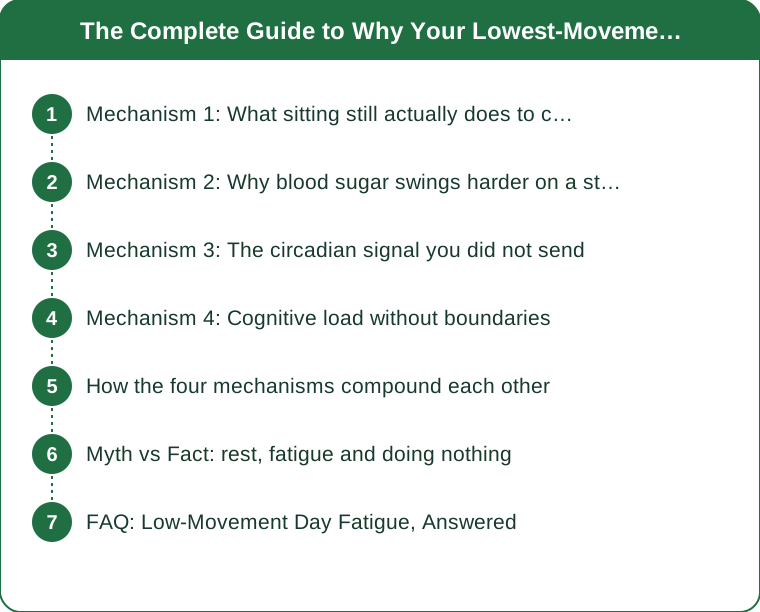
Mechanism 1: What sitting still actually does to circulation and oxygen delivery
Sustained static posture is metabolically strange. Your muscles are not working hard, but many of them are working continuously at a low level to hold a position - the postural muscles of the back, neck and hips never fully switch off during a seated day.
Continuous low-level contraction restricts blood flow through those muscles. Blood flow is how oxygen arrives and how metabolic byproducts leave, so a muscle held at 10 percent contraction for three hours accumulates the sensations of fatigue without the corresponding work.
The venous return problem compounds it. The calf muscle acts as a secondary pump that pushes blood back toward the heart. Sitting still switches that pump off, so blood pools in the lower legs, circulating volume drops slightly, and heart rate rises modestly to compensate. That is part of why standing up after two hours produces a brief lightheaded moment.
Cerebral oxygen delivery is affected too. Studies of prolonged sitting have found measurable reductions in blood flow to the brain over several hours of uninterrupted sitting, with the reduction largely prevented by short walking breaks. Two minutes of walking every 30 minutes is the intervention that keeps showing up.
What to do: set a timer for every 30 minutes and stand for two. Not a stretch routine - just standing, walking to the kitchen, going up a flight of stairs. The frequency matters far more than the duration or the quality of the movement. Eight two-minute breaks beat one 16-minute walk for this specific mechanism, because the problem is duration of stillness rather than total activity.
Mechanism 2: Why blood sugar swings harder on a still day
This is the mechanism most people have never heard and it explains a great deal of the afternoon collapse.
After a meal, glucose has to leave your bloodstream and enter cells. Insulin drives most of that. But contracting muscle takes up glucose through a pathway that does not require insulin at all - a mechanism that switches on when muscle contracts and switches off when it does not.
On a day with normal movement, that second pathway is quietly handling a substantial share of your post-meal glucose. On a still day, it is essentially offline, so the same lunch produces a higher glucose peak, a larger insulin response, and a steeper drop afterward.
That steeper drop is the 2:30 wall. It is not a lack of willpower or a poorly chosen sandwich - it is the same sandwich processed without one of the two systems that normally handles it.
The interventions are unusually effective here. A 10 to 15 minute walk after a meal produces a meaningful reduction in the post-meal glucose peak. Even two to three minutes of walking every 30 minutes has been shown to blunt post-meal glucose swings compared with uninterrupted sitting.
Protein and fiber at lunch help for the same reason from the other direction - they slow the rate at which glucose arrives, which lowers the peak that your reduced clearance capacity has to handle. A lunch of a refined-carbohydrate base with little protein is the worst possible pairing with a still afternoon, which is unfortunately the standard desk lunch.
Mechanism 3: The circadian signal you did not send
Your internal clock is set primarily by light, and secondarily by movement, meal timing and temperature change. A low-movement indoor day sends a weak version of every one of those signals.
Light is the big one. Indoor lighting typically runs 100 to 500 lux. An overcast morning outdoors is around 1,000 to 10,000 lux, and direct sun far more. That difference is not perceptual - your eyes adapt so a room feels bright - but the circadian system responds to absolute intensity, and indoor light is roughly an order of magnitude too weak to give a strong morning signal.
A weak morning signal produces a flatter cortisol rise in the morning, a less distinct alertness peak, and a less consolidated sleep drive that night. You feel foggy during the day and mildly wired at bedtime, which sets up the following day to be worse.
Temperature variation matters too. Your core temperature naturally rises through the morning and falls in the evening, and that rhythm is reinforced by movement and by exposure to varying environments. A day in one climate-controlled room at one temperature flattens it.
Meal timing is the third input. Irregular eating on a shapeless day sends conflicting timing signals to peripheral clocks in the liver and gut.
What to do: get outside within an hour of waking for 10 to 15 minutes, no sunglasses, even on an overcast day - an overcast morning still delivers vastly more light than any indoor room. Add a second outdoor break at midday. Keep meals at roughly consistent times even when the day has no other structure. These are small actions with disproportionate returns, and they are almost entirely free.

Mechanism 4: Cognitive load without boundaries
The fourth mechanism is not physiological in the same way, and it may be the largest on a work-from-home or an admin-heavy day.
Attention is expensive to switch. Each time you move between tasks there is a cost - a period where residual attention from the previous task degrades performance on the new one. On a fragmented day of email, messages, small decisions and interruptions, you may switch context dozens of times an hour.
The cost is invisible because no single switch feels expensive. What you notice is the aggregate: a day that produced very little visible output and left you completely depleted.
Physical work has natural boundaries and this does not. A day of moving boxes has an obvious start and stop, and the fatigue is proportionate to visible output. A day of fragmented cognitive work has neither, so your brain never receives the signal that a unit of work is complete.
Decision fatigue is layered on top. A large volume of small, low-stakes decisions degrades the quality and increases the felt effort of later decisions in the same day. Answering forty trivial questions is more tiring than answering four significant ones.
What to do: create artificial boundaries. Work in blocks of 45 to 50 minutes on a single category of task, then take a genuine break away from the screen. Batch the small decisions into one window rather than letting them arrive continuously. And define what done looks like before starting - an open-ended task never sends a completion signal, so it keeps drawing resources long after you stopped working on it.
How the four mechanisms compound each other
None of these operate alone, and the compounding is why a still day can feel worse than a genuinely hard one.
Poor morning light gives you a flat alertness curve. The flat curve makes focused work harder, so you fragment your attention more. The fragmentation keeps you at the desk longer without breaks. The lack of breaks worsens circulation and removes the muscle glucose pathway. The larger glucose swing produces an afternoon crash. The crash gets treated with caffeine at 3pm, which delays sleep onset that night. Short or late sleep produces a worse morning, and the cycle restarts with less margin.
The intervention point matters more than the intervention size. Because the loop is self-reinforcing, small changes early in the chain outperform large changes later. Fifteen minutes of morning outdoor light is a smaller effort than an evening workout and does more to break the cycle, because it acts before the compounding starts.
Which is also why more sleep does not fix it. You can sleep nine hours after a fragmented, still, dim day and still feel unrested, because three of the four mechanisms were never about sleep debt. People add sleep, see little change, and conclude something is medically wrong - when the actual issue is that the day itself never sent the signals that make a day feel like a day.
Ranked by return on effort: morning outdoor light first, movement breaks every 30 minutes second, a post-lunch walk third, task boundaries fourth. If you only do one, do the first.
Myth vs Fact: rest, fatigue and doing nothing
Myth: If you are tired, you need more rest. Fact: fatigue from low movement, dim light and fragmented attention does not respond to rest, because rest supplies more of the same conditions that produced it. It responds to movement, light and structure. Genuine sleep debt is a different problem with a different fix, and confusing the two is the most common reason people stay stuck.
Myth: A hard workout is the answer to a sedentary day. Fact: an evening workout is good for you and does surprisingly little for this specific pattern. Research on prolonged sitting consistently finds that breaking up sitting time has effects that a single bout of exercise does not fully replicate. Frequency beats intensity here.
Myth: The afternoon crash is caused by lunch. Fact: lunch is a contributing factor, not the cause. The same meal on an active day produces a much smaller dip. Blaming the sandwich leads people to skip lunch, which makes the afternoon worse rather than better.
Myth: Working through a slump is more efficient than breaking. Fact: performance during a slump is poor enough that the time is largely wasted, and the fatigue carries into the next hour. A ten-minute walk is one of the few interventions that reliably improves the following hour of output.
Myth: Caffeine solves the 3pm dip. Fact: it masks it for two to three hours and, taken that late, meaningfully reduces sleep quality that night for many people, which loads the following day. If you need caffeine, take it before roughly 2pm and pair it with movement rather than as a substitute for it.
FAQ: Low-Movement Day Fatigue, Answered
How much movement is actually enough on a desk day?
Aim for two to three minutes every 30 minutes, which is about 30 to 45 minutes of accumulated light movement over a workday. That threshold appears repeatedly in sitting-interruption research and it is far lower than most people expect.
I get 8 hours of sleep and still feel this way. What is going on?
Three of the four mechanisms here have nothing to do with sleep quantity, so adequate sleep does not protect against them. If good sleep plus movement, light and structure for two weeks does not change anything, that is the point to check in with a doctor - persistent fatigue can have medical causes including thyroid issues, iron deficiency and sleep disorders.
Does a standing desk fix it?
Partly. Standing improves the venous return problem and burns marginally more energy, but static standing is still static - it has its own discomfort profile. The benefit comes from alternating positions and from actually moving, not from standing still for six hours instead of sitting still for six hours.
Is the morning light thing really that important?
It is the highest-return item on the list for most people. Ten to fifteen minutes outdoors within an hour of waking, without sunglasses, on any weather. It costs nothing, it acts at the start of the causal chain, and most people notice a difference within about a week.
This is general information, not medical advice. Persistent or unexplained fatigue should be evaluated by a healthcare professional.
TL;DR:
- Low-movement days drain you through four mechanisms: restricted circulation, larger blood sugar swings, weak circadian signals, and boundaryless cognitive load.
- Muscle contraction clears glucose through a pathway that does not need insulin - without movement, the same lunch produces a much bigger crash.
- Indoor light is roughly an order of magnitude too dim to set your clock properly, which is why morning outdoor light is the single highest-return fix.
- The mechanisms compound, so early interventions beat large ones: light, then movement breaks every 30 minutes, then a post-lunch walk, then task boundaries.
- More sleep does not fix it, because most of this was never a sleep problem.
The strange part of this pattern is how much better it responds to small, frequent, unimpressive actions than to big ones. Two minutes of standing every half hour and a quarter hour of morning daylight sounds far too minor to matter against a day that flattened you. It is, reliably, the thing that works.
Keep Reading
This article is for general informational purposes only and is not medical advice. Always consult a qualified health professional for guidance specific to you.