Why August Humidity Drains Your Energy More Than the Heat Itself
Quick Answer: Humidity drains you because it disables your main cooling system. Sweat only cools when it evaporates, and on a high-dew-point day it cannot - so your heart works harder pushing blood to the skin, your core temperature creeps up, and your body spends real energy on cooling that accomplishes nothing. Add the poor sleep that humid nights produce and the mild dehydration that constant sweating causes, and the wrung-out feeling is fully explained. Check the dew point, not the temperature: under 60F is comfortable, over 70F is oppressive at any temperature.
You handled 95 degrees in July fine. Now it is 87 and you feel like you are walking through soup with a weighted vest on. Nothing is wrong with you. Something specific is different about the air, and once you can name it you can schedule around it.

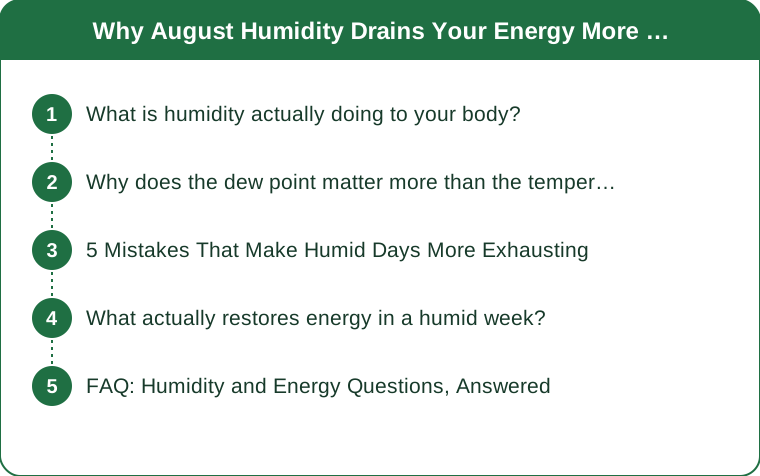
What is humidity actually doing to your body?
Turning your best cooling system into an expensive decoration.
Sweating does not cool you. Evaporation does. When sweat converts from liquid to vapor, it pulls a large amount of heat from your skin - that phase change is the whole trick. On a dry day the system is so efficient you barely notice it running.
High humidity blocks the evaporation step. When the air is already carrying near its capacity of water vapor, your sweat has nowhere to go. It sits on your skin, drips, and soaks your shirt - all cooling losses of essentially zero. The body responds the only way it can: more sweat, and more blood shunted to the skin to dump heat by direct contact with air, which barely works either.
That blood shunt is the fatigue you feel. Cardiac output is finite. When a big share of it is routed to your skin for cooling, less is available for muscles and gut and brain. Researchers measure meaningfully higher heart rates for identical tasks on humid days - your heart is literally doing more work while you accomplish the same errand. That is not perceived effort. That is effort.
Core temperature drifts up anyway. Even with maximum sweat output, a humid afternoon walk can raise core temperature more than a hotter dry day would. A body running warm down-regulates - your pace slows, motivation sags, and thinking feels slightly padded. This is protective and automatic.
And the fluid math compounds daily. Sweating heavily without cooling means losing water and electrolytes at a high rate for no benefit. Even 1 to 2 percent dehydration measurably reduces energy, mood, and concentration - and most people run at least that low by late afternoon in a humid week.
Why does the dew point matter more than the temperature?
Because it measures the thing your body actually fights.
Relative humidity is a percentage of a moving target - 90 percent humidity at 60F is a pleasant morning, while 45 percent at 95F can be brutal. It confuses more than it informs.
Dew point is absolute. It tells you how much water the air is actually holding, which directly determines how fast sweat can evaporate. It is the single most useful number in a summer forecast, and most weather apps show it one tap deep.
The scale that predicts your day:
- Under 55F dew point: dry, crisp. Sweat vanishes; effort feels honest.
- 55 to 63F: comfortable to slightly noticeable. Most of a normal summer.
- 64 to 69F: sticky. Workouts feel about a level harder than they are.
- 70 to 74F: oppressive. Everything outdoors costs extra; energy fades early.
- 75F and up: tropical. Genuine heat-stress territory even at modest temperatures.
Late August in much of the eastern half of the US lives between 65 and 75. That is why this month produces the soup feeling more than the technically hotter weeks of early July did - peak dew points typically lag peak temperatures by weeks, because warm oceans and saturated ground keep feeding moisture into the air.
The practical use is scheduling. Dew point usually bottoms out early morning. An errand or a walk at 8am at dew point 66 costs a fraction of the same task at 4pm at dew point 73. Same day, same you, different price.
And humid nights are the hidden half. Sleep needs a falling core temperature. A bedroom at 78F with saturated air fights that drop all night, producing lighter, more fragmented sleep - which you then bill to tomorrow as mysterious tiredness.

5 Mistakes That Make Humid Days More Exhausting
1. Hydrating with plain water only. Heavy sweating for hours takes sodium with it, and replacing pure water without electrolytes dilutes what is left - the flat, slightly headachy feeling of a long humid day. On big-sweat days, salt your food normally and make one drink an electrolyte one. Iced coffee, for the record, is mostly water and mostly fine - but it is not the whole plan.
2. Scheduling the hardest thing at 5pm. The temptation is to wait out the midday sun, but dew point and accumulated ground heat make late afternoon the most expensive slot of the day. The cheap hours are before 9am. Move the run, the yard work, and the big grocery haul there and the same tasks cost visibly less.
3. Blasting the AC to arctic and bouncing through 25-degree swings. Repeated hard transitions between a 68F office and 90F humid air keep your thermoregulation working all day. You cannot avoid transitions, but a moderate indoor setting around 74 to 76F narrows the swing your body pays for a dozen times a day.
4. Eating one giant heavy lunch. Digestion produces heat and competes for the same blood supply your skin is demanding. The post-lunch dip is deeper on humid days for exactly this reason. Two lighter eating occasions beat one heavy one when the air is thick.
5. Treating week one like week four. Acclimatization is real - the body genuinely adapts to humid heat over 10 to 14 days of regular moderate exposure, sweating earlier and losing less salt. The first properly humid week of a spell is the worst it will feel. Staying entirely in AC forfeits the adaptation, then charges you full price on every trip outside.
What actually restores energy in a humid week?
Six moves, ranked by how much they give back.
1. Shift the day earlier. The single biggest lever. Morning dew point plus a cooler ground surface means the same walk, workout, or errand run costs roughly a difficulty level less before 9am. Humid weeks reward larks, so borrow their schedule temporarily.
2. Fix the bedroom before fixing anything else. Sleep is where a humid week compounds. Aim the room at 65 to 70F with dry air - AC in dry mode, or a dehumidifier if you sleep with windows open. Pulling bedroom humidity down transforms sleep quality faster than any supplement, and better sleep repays tomorrow’s energy directly.
3. Cool the pulse points instead of chugging more. Cold water on wrists and the back of the neck, or a cool shower before bed, drops perceived temperature fast by cooling blood where it runs shallow. It spares your sweat system some work and it is free.
4. Downshift intensity on purpose, not by surrender. On dew points above 70, run slower, lift the same but rest longer, walk instead of jog - deliberately. Effort in humid heat produces less fitness per unit of fatigue, so the smart trade is volume over intensity until the air breaks. Athletes call this training by feel; in August it is just honesty.
5. Keep sodium and potassium in the picture. Normal food salting plus produce-heavy meals covers most people. A long outdoor day earns an electrolyte drink. Persistent fatigue with cramps or dizziness is past self-management - that deserves a checkup rather than another sports drink. This is general information, not medical advice.
6. Watch for the break. Humid spells end - a front comes through, dew point drops 15 degrees overnight, and everyone’s energy mysteriously returns the same morning. Knowing the tiredness is weather-shaped, with an end date in the forecast, is itself worth something: you stop treating a Tuesday feeling as a life problem.
FAQ: Humidity and Energy Questions, Answered
Why does humidity make me so tired?
Because it blocks sweat evaporation, your only powerful cooling system. Your heart pumps extra blood to your skin trying to shed heat, core temperature creeps up anyway, and your body down-regulates energy to protect itself - while heavy, useless sweating drains fluids and electrolytes. Add the shallow sleep humid nights cause, and the exhaustion is fully accounted for.
What dew point starts to feel uncomfortable?
Most people notice stickiness around a 64F dew point, find 70F oppressive, and struggle above 75F regardless of the actual temperature. Below 60F feels comfortable almost universally. Checking dew point instead of temperature will predict your energy far more accurately in August.
Is it better to exercise in the morning or evening in humid weather?
Morning, clearly. Dew point and surface heat are both lowest before about 9am, so the same workout produces less cardiovascular strain and less fluid loss. Evening feels cooler than midday but usually carries the day’s peak mugginess and stored ground heat.
Does drinking more water fix humidity fatigue?
Only partly. Fluid matters, but on heavy-sweat days you also lose sodium, and replacing sweat with plain water alone can leave you flat and headachy. Salt food normally, include an electrolyte drink on long outdoor days, and prioritize sleep and scheduling - the fatigue is a cooling problem more than a thirst problem.
TL;DR:
- Humidity blocks sweat evaporation, so your heart works harder for cooling that never happens.
- Dew point is the number to watch: under 60F easy, over 70F oppressive at any temperature.
- Late August is peak dew point season - the air is heavier now than in hotter early July.
- Move hard tasks before 9am and dry the bedroom; those two changes return the most energy.
- Electrolytes on big-sweat days, moderate AC settings, and two weeks of patience for acclimatization.
You are not weaker than you were in June. The air is thicker than it was in June, and it prices every task accordingly. Schedule around it and take the refund.
Keep Reading
This article is for general informational purposes only and is not medical advice. Always consult a qualified health professional for guidance specific to you.