The Post-Lunch Crash: Why It Happens and How to Build a Lunch That Does Not
Quick Answer: The post-lunch crash is three things happening at once: a natural dip in your circadian alertness rhythm that occurs around 1 to 3pm whether or not you eat, a blood glucose rise and fall driven by how fast the meal digests, and a shift in blood flow and hormone signaling after eating. You cannot remove the circadian dip, but you can flatten the glucose curve - which is the part most people feel most sharply.
The lunch that avoids it has protein, fiber, and fat in front of the carbohydrate, and it is smaller than you think.

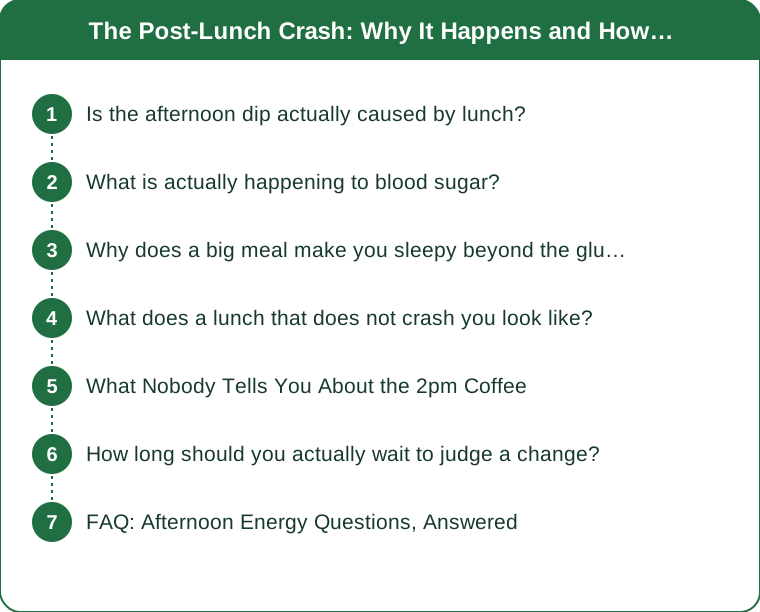
Is the afternoon dip actually caused by lunch?
Only partly, and the part that is not caused by lunch is the larger one.
Human alertness follows a biphasic pattern - a long rise through the morning, a pronounced dip in the early afternoon, a secondary rise in the early evening, then the drop toward sleep. This post-lunch dip in alertness appears in sleep research even in people who have not eaten at all, which is the clearest evidence that it is a clock phenomenon rather than a digestion one.
The dip typically falls somewhere between 1pm and 4pm, and its exact timing tracks your individual chronotype. A person who naturally wakes at 6am tends to dip earlier than someone who wakes at 9am. This is also why the dip arrives at almost the same time every single day - a clock is a much more consistent thing than a lunch.
So the baseline is: some drop in alertness at this hour is normal, expected, and not a sign of anything wrong with your diet or your discipline.
What lunch does is modify the depth of that dip. A meal that produces a large glucose swing lands its downswing right in the middle of a period when you are already at your circadian low. The two effects stack, and the result is the specific heavy, foggy feeling people describe rather than a mild dullness.
The practical framing that helps most: you are not trying to eliminate the dip. You are trying to avoid making it worse. That is a solvable problem, whereas eliminating it is not.
This also explains why the dip feels dramatically worse on some days than others despite the same schedule. The clock component is constant. The meal component is the variable, and it is the one you control.
What is actually happening to blood sugar?
The shape of the curve matters far more than the peak, and this is where most advice goes wrong.
When you eat carbohydrate, blood glucose rises. Insulin is released in response and moves glucose out of the bloodstream into cells. In a healthy system, glucose returns to baseline over roughly two to three hours.
The problem is the rate. A meal that is mostly rapidly-digesting carbohydrate - white bread, a large portion of rice, a sweetened drink, most sandwich-and-crisps combinations - produces a fast, high rise. A fast rise triggers a proportionally large insulin response, and a large insulin response frequently overshoots, pulling glucose down below where it started.
That undershoot, sometimes called reactive hypoglycemia in its more pronounced form, arrives roughly 90 minutes to two hours after eating. Eat at 12:30 and the low point lands around 2pm, directly on top of the circadian dip.
Several things change the shape of that curve:
- Protein and fat slow gastric emptying, so the same amount of carbohydrate enters the bloodstream over a longer window and the peak is lower and flatter.
- Fiber, particularly soluble fiber, forms a viscous gel in the gut that slows glucose absorption directly.
- Order of eating matters measurably. Studies on meal sequencing have found that eating vegetables and protein before the carbohydrate portion of the same meal meaningfully lowers the glucose peak - the food is identical, only the order changes.
- Total carbohydrate load matters more than the type once the portion gets large. A very large serving of even a slow carbohydrate will produce a substantial rise.
None of this requires cutting carbohydrate out. It requires putting something in front of it and keeping the portion reasonable.
Why does a big meal make you sleepy beyond the glucose effect?
There are two additional mechanisms, and both are real but smaller than most people assume.
Blood flow redistribution. After a large meal, blood flow to the digestive tract increases substantially to support absorption. The old story is that this steals blood from the brain and causes drowsiness. The truth is more moderate - the body maintains cerebral blood flow tightly, and it does not drop meaningfully after eating. So this mechanism is largely folklore in its strong form, though a very large meal does produce a genuine systemic response.
Hormonal and neural signaling. This is the better-supported one. Eating triggers the release of gut hormones including cholecystokinin, and activates the parasympathetic nervous system - the rest-and-digest branch. Parasympathetic activation produces exactly what it sounds like: reduced arousal, slower heart rate, a shift away from alertness. This is a coordinated physiological state, not an accident.
There is also a specific effect involving tryptophan. A high-carbohydrate, low-protein meal raises insulin, which clears most competing amino acids from the bloodstream but not tryptophan. That leaves tryptophan relatively more available to cross into the brain, where it is a precursor to serotonin and then melatonin. The effect is modest and it takes a fairly extreme meal composition to matter much, but it is a real mechanism and it points in the same direction: a lunch that is almost entirely carbohydrate is the worst case on multiple fronts simultaneously.
The practical upshot is that meal size is an independent variable from meal composition. A perfectly balanced but very large lunch will still produce drowsiness through sheer parasympathetic activation. Portion is not a detail.

What does a lunch that does not crash you look like?
Concrete, with numbers, because vague advice about balance does not survive a busy Tuesday.
Protein: 25 to 35 grams. This is the anchor. It slows digestion, blunts the glucose curve, and supports satiety through the afternoon. In practice: a chicken breast, a large tin of fish, two eggs plus a serving of Greek yogurt, a substantial portion of tofu or beans plus a protein source.
Fiber: 8 to 10 grams. Mostly from vegetables and whole grains rather than a supplement. A large mixed salad or two servings of vegetables gets most of the way there.
Fat: a real but not enormous amount. Half an avocado, a tablespoon of olive oil, a handful of nuts. Fat is the most effective single lever for slowing gastric emptying, but it is also the most calorie-dense, so it is easy to overshoot.
Carbohydrate: present, but portioned and last. A fist-sized serving of a whole grain, eaten after you have made a start on the protein and vegetables. Not eliminated - carbohydrate restriction at lunch tends to produce its own crash from a different direction, and it drives people toward a large snack at 4pm.
Total size: moderate. If you finish lunch feeling genuinely full rather than satisfied, the parasympathetic response alone will produce drowsiness regardless of composition. Aim for the point where you would happily stop, not the point where you have to.
A template that works and takes four minutes: a base of leafy greens, a substantial protein, a fist of a whole grain, something with fat, and a dressing that is oil rather than sugar-based. Eat the greens and protein first. It is not exciting, but it is the difference between working at 2:15 and rereading the same paragraph.
What Nobody Tells You About the 2pm Coffee
The afternoon coffee is not neutral, and its cost lands about nine hours later.
Caffeine has a half-life of roughly 5 to 6 hours in most adults, and considerably longer in some - genetic variation in the enzyme that metabolizes it produces a range from about 2 hours to over 8. A 200mg coffee at 2pm means roughly 100mg still circulating at 8pm and around 50mg at 2am for an average metaboliser. For a slow metaboliser, substantially more.
That residual caffeine does not necessarily stop you falling asleep. What it reliably does is reduce deep slow-wave sleep, the stage most responsible for feeling restored. So the mechanism is quietly self-perpetuating: the afternoon coffee degrades tonight’s sleep quality, which deepens tomorrow’s afternoon dip, which makes tomorrow’s coffee feel more necessary.
Three things that break the loop:
- Move the cutoff earlier, not to zero. For most people a hard stop at around 1 to 2pm is enough. You do not need to give up caffeine, only to stop treating the afternoon as fair game.
- A 10 to 20 minute walk outdoors beats a coffee for the dip specifically. Light exposure suppresses melatonin and directly raises alertness, and movement raises core temperature. It works within minutes and costs nothing at 2am.
- A short nap, if genuinely available, is the most effective intervention of all - but keep it under 25 minutes to avoid waking out of deep sleep feeling worse than before.
The uncomfortable version: for a lot of people, the afternoon crash is not primarily a lunch problem or a caffeine problem. It is a sleep debt problem showing up at the hour when the circadian clock is least able to mask it.
How long should you actually wait to judge a change?
Longer than one afternoon, and this is where most attempts fail.
If you change your lunch tomorrow and still feel foggy at 2pm, the natural conclusion is that it did not work. That conclusion is usually wrong, for three reasons.
The circadian component does not change. Some dip will still be there. If you are measuring against feeling nothing at all, every change will look like a failure. The realistic target is a dip you can work through rather than one that stops you.
Sleep debt dominates for the first few days. If you are running a deficit, that will overwhelm any dietary change. A fair test requires a stretch of reasonable sleep alongside it, which is why single-day experiments are so unreliable.
Habituation to a different meal size takes about a week. A moderate lunch after a period of large lunches will feel insufficient at first - not because it is, but because your hunger signaling is calibrated to the previous pattern. That recalibration takes roughly 5 to 10 days.
A reasonable protocol: hold the new lunch pattern for two weeks, keep the timing consistent within about 30 minutes each day, and rate your 2 to 3pm alertness out of 10 rather than trying to remember how it felt. Written numbers reveal trends that memory flattens.
What most people find after two weeks is not that the dip disappeared, but that it moved from something that ended their productive day to something that lasted about 40 minutes. That is the realistic and genuinely worthwhile outcome. This is general information, not medical advice - persistent, severe afternoon fatigue that does not respond to sleep and food changes is worth raising with a doctor, since thyroid issues, anemia, and blood sugar dysregulation all present this way.
FAQ: Afternoon Energy Questions, Answered
Would skipping lunch entirely avoid the crash?
It avoids the glucose component but not the circadian one, and it usually backfires. People who skip lunch commonly report a sharper drop by 3 to 4pm plus significant overeating in the evening. The dip is a clock event - fasting through it does not remove it.
Does a walk right after eating actually help?
Yes, and this one is well supported. A short walk of even 10 to 15 minutes after a meal measurably reduces the glucose peak, because working muscle takes up glucose without requiring much insulin. It is one of the highest-return-per-minute interventions available for this specific problem.
Why is the crash worse on some days with the same lunch?
Usually sleep the night before, which sets how deep the circadian dip goes. Second most common is meal timing - eating an hour later shifts the glucose downswing to a different point relative to your clock. Third is hydration, which has a smaller but real effect on perceived alertness.
Is a high-fat, very low-carb lunch the answer?
It does flatten the glucose curve, and some people do well on it. But a very large fat load produces its own sluggishness through slow gastric emptying, and cutting carbohydrate hard at lunch often shows up as a strong craving around 4pm. Moderate and ordered beats extreme in most cases.
TL;DR:
- The 1 to 3pm dip is primarily circadian and happens whether or not you eat - the goal is to avoid deepening it, not to remove it.
- A fast glucose rise triggers an overshooting insulin response whose low point lands about 90 to 120 minutes later, right on the dip.
- Protein, fat, and fiber slow gastric emptying; eating vegetables and protein before the carbohydrate measurably lowers the peak with identical food.
- Aim for roughly 25 to 35g protein, 8 to 10g fiber, a portioned whole grain last, and a moderate total size.
- A 10 to 20 minute outdoor walk beats an afternoon coffee, which costs you deep sleep nine hours later and feeds the loop.
- Judge any change over two weeks, not one afternoon - sleep debt and hunger recalibration both muddy the first few days.
The realistic win is not a dip-free afternoon. It is a 40-minute dip instead of a lost half-day. This is general information, not medical advice.
Keep Reading
This article is for general informational purposes only and is not medical advice. Always consult a qualified health professional for guidance specific to you.