Why Your Afternoon Energy Changes as Soon as the Days Start Shortening
Quick Answer: By mid-August most of the northern US has already lost around an hour of daylight since the June solstice, and the loss accelerates through September. Less afternoon light means a weaker light signal to your body clock, an earlier melatonin rise, and an afternoon dip that arrives sooner and hits harder. The fixes are light timing - morning light within an hour of waking, a genuine outdoor break between 2pm and 4pm - plus protein at lunch and a consistent wake time. None of it requires more sleep.
Nothing has changed. Same bedtime, same coffee, same work. But somewhere in the last two weeks, 3pm started feeling like 5pm used to. This is not in your head, and it is not the start of a long decline - it is a predictable response to a change in light that most people never connect to how they feel.

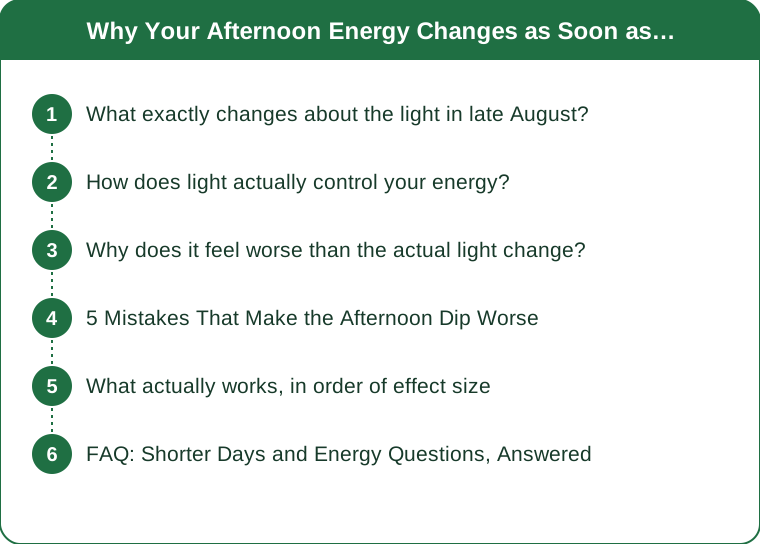
What exactly changes about the light in late August?
More than people expect, and faster than they expect.
The daily loss accelerates after the solstice. In late June, day length shrinks by well under a minute a day. By mid-August, at the latitude of New York or Chicago, it is more than two minutes a day, and by the equinox in late September it peaks at close to three. That means the change you are feeling now is not gradual - it is the steepest part of the whole year.
Cumulatively, mid-August has already lost around an hour of daylight compared with the longest day, and almost all of that loss comes off the evening end plus a later sunrise. The afternoon that used to be flooded with light at 5pm is noticeably dimmer.
The angle changes as well as the duration. The sun sits lower, so light comes through windows at a shallower angle and travels through more atmosphere, which shifts its colour warmer and reduces the intensity of the blue wavelengths that your body clock is most sensitive to. A room that felt bright in July can be delivering meaningfully less clock-relevant light in late August at the same hour.
Indoor light does not compensate. A well-lit office is typically 300 to 500 lux. An overcast day outdoors is around 10,000 lux, and full sun is well over 50,000. The gap between indoor and outdoor light is not a matter of degree - it is one to two orders of magnitude, which is why sitting near a lamp does nothing to the system that a five-minute walk outside changes immediately.
And the weather participates. Late August into September brings more overcast days in most of the country, which stacks on top of the astronomical loss. Two dim weeks in a row is when most people notice the change and start blaming their sleep.
How does light actually control your energy?
Through a specific pathway, not a vague one.
Specialised cells in your retina - separate from the ones you see with - contain a pigment called melanopsin that responds primarily to blue-wavelength light. They report to the suprachiasmatic nucleus in the hypothalamus, which is the master clock for essentially every daily rhythm in the body.
That clock sets the timing of melatonin. Melatonin release begins in the evening when the light signal drops, and it is the signal that makes you feel like winding down. When the afternoon light signal weakens earlier in the day, the whole curve can shift earlier - which is felt not as sleepiness at bedtime but as a heavy, foggy afternoon.
Cortisol has the opposite curve. It peaks shortly after waking - the cortisol awakening response - and declines through the day. A strong morning light signal sharpens that peak, which produces a more alert morning and, because the curve is steeper, a cleaner afternoon. Weak morning light flattens the whole thing.
Core body temperature runs on the same clock, dipping in the early hours and again, mildly, in the mid-afternoon. That mid-afternoon temperature dip is a genuine physiological event - the post-lunch dip exists in people who skip lunch entirely - and anything that shifts the clock earlier moves the dip earlier too.
Serotonin is the fourth piece. Bright light exposure is associated with higher serotonin activity, which affects mood and, indirectly, perceived energy. This is the mechanism behind seasonal mood change, and it does not switch on in December - it begins its slide now.
The practical upshot: your afternoon energy is downstream of a light signal you received hours earlier, mostly in the morning. Which is why the fix is not caffeine at 3pm.
Why does it feel worse than the actual light change?
Because three other things are happening at the same time and nobody separates them.
Summer sleep debt is being invoiced. Late sunsets push bedtimes later through July and August while wake times stay fixed for work. A 30-minute nightly shortfall across six weeks is a substantial accumulated debt, and the point at which people notice it is usually when something else changes - like the light.
The schedule tightens abruptly. School terms, autumn project cycles, and the end of colleagues’ holidays all land in the same fortnight. Cognitive load goes up sharply, and cognitive load has an energy cost that people rarely account for.
Activity often drops. The evening walk that happened naturally at 8pm in daylight quietly stops happening when 8pm is dark, and the reduction in daily movement reduces daytime energy - the relationship runs in the direction most people find counterintuitive.
Hydration slips. People drink less water as the weather cools while sweat losses are still meaningful in a warm late-August week. Even mild dehydration reliably produces fatigue and reduced concentration in controlled studies.
And there is an expectation effect. Summer carries an implicit promise of feeling good, so feeling flat in August registers as wrong in a way that feeling flat in February does not. The same energy level in November would barely be remarked on.
Separating these matters because they have different fixes. If your afternoon dip is sleep debt, more light will not fix it. If it is light, an extra hour in bed will not fix it either. Most people in late August have some of both.

5 Mistakes That Make the Afternoon Dip Worse
1. Fighting it with more coffee after 2pm. Caffeine has a half-life of around five hours, meaning a quarter of a 3pm coffee is still circulating at 1am. It reduces deep sleep quality even when it does not stop you falling asleep, which produces a worse afternoon tomorrow. The 3pm coffee is borrowing energy from the 3pm you of tomorrow, at interest.
2. Eating a large, carbohydrate-heavy lunch. The post-lunch dip exists regardless, but a big high-glycaemic lunch measurably deepens it. A lunch built around protein and fibre with a moderate carbohydrate portion produces a much shallower curve. Not no carbohydrates - moderate ones, with something alongside them.
3. Staying inside all day and blaming your sleep. This is the most common one. People respond to an afternoon dip by targeting bedtime, which is the wrong end of the day. The intervention with the strongest evidence is morning light exposure, and the second strongest is an outdoor break in the early afternoon.
4. Napping for an hour. A 10 to 20 minute nap is genuinely restorative and does not produce grogginess. Somewhere past 30 minutes you enter deep sleep, and waking out of deep sleep produces sleep inertia that can last an hour and makes the rest of the afternoon worse than no nap at all.
5. Letting the wake time drift at weekends. A two-hour weekend lie-in is a two-hour time zone shift applied to your body clock twice a week. It is the reason Monday and Tuesday afternoons are frequently the worst of the week. Keeping wake time within about an hour across all seven days does more for weekday energy than almost anything else - and the third item on this list gets a lot easier once this one is stable.
What actually works, in order of effect size
Six interventions, ranked.
1. Morning outdoor light, within an hour of waking, 10 to 20 minutes. On a clear day, five minutes may be enough; on a heavily overcast one, aim for 20 or more. It does not need to be a walk - standing outside with a coffee counts, and so does eating breakfast on a step. Do not wear sunglasses for it. This is the highest-leverage thing on the list and it is free.
2. An outdoor break between 2pm and 4pm. Ten minutes, ideally walking. This directly counters the shrinking afternoon light signal and adds a movement stimulus at exactly the point in the circadian temperature curve where you are dipping. People consistently report this as the change they can feel the same day.
3. Protein-forward lunch. Aim for 25 to 35g of protein at midday with fibre alongside, and keep the refined carbohydrate portion modest. This flattens the glucose curve and takes a substantial bite out of the dip.
4. A fixed wake time, seven days a week. Within an hour, including weekends. It is the anchor that everything else on this list hangs from.
5. Movement at the dip, not rest. Five minutes of anything - stairs, a brisk loop of the building, twenty squats. The instinct at 3pm is to sit more heavily, and it is exactly wrong. Movement raises core temperature and alertness within minutes.
6. Hydration and a check on the basics. 500ml of water at the dip is a genuinely common fix. And if fatigue is persistent, severe, or accompanied by other symptoms, get iron, ferritin, thyroid function, and vitamin D checked rather than optimising your light exposure indefinitely. This is general information, not medical advice.
What to skip: afternoon caffeine after 2pm, long naps, and expensive light therapy devices before you have tried actually going outside. A therapy lamp is a reasonable tool in December in a northern winter; in August it is solving a problem that a door already solves.
How long before any of this works? The light interventions produce a noticeable difference within three to five days for most people, and a stable one within two weeks. The wake-time anchor takes longer - about two weeks of consistency before the body clock settles into it, and the first week genuinely feels worse before it feels better. Lunch composition changes are the fastest of the lot; you can feel the difference the same afternoon.
And the thing to measure is not energy, it is the shape of the day. Ask whether the dip arrives at 2pm or 4pm, and whether it lasts 40 minutes or two hours. Those two numbers move well before anyone would describe themselves as feeling more energetic, and they are the honest early signal that the intervention is working.
FAQ: Shorter Days and Energy Questions, Answered
Why am I tired in August when it is still summer?
Day length has already dropped by around an hour since the June solstice and is falling by more than two minutes a day, which weakens the light signal your body clock depends on. Add accumulated summer sleep debt and a schedule that tightens in late August, and a genuine energy dip is the expected outcome.
Does morning light really help afternoon energy?
Yes, and it is the intervention with the strongest evidence. Bright light within an hour of waking sharpens the cortisol awakening response and stabilises the timing of the whole daily curve, which produces a shallower afternoon dip several hours later. Ten to twenty minutes outdoors, without sunglasses.
Is the post-lunch dip caused by lunch?
Only partly. It occurs even in people who skip lunch, because it is driven by a genuine circadian dip in core body temperature and alertness in the early afternoon. Lunch composition changes how deep it is - a large refined-carbohydrate meal deepens it, a protein-and-fibre meal flattens it.
When should I see a doctor about tiredness?
If fatigue is persistent for more than a few weeks despite good sleep, if it is severe enough to interfere with normal activities, or if it comes with unexplained weight change, breathlessness, low mood, or any other new symptom. Iron, thyroid, and vitamin D are worth checking rather than assumed. This is general information, not medical advice.
TL;DR:
- Mid-August is the steepest part of the annual day-length change - over two minutes lost per day.
- Weaker afternoon light shifts your body clock earlier, so the dip arrives sooner and deeper.
- Morning outdoor light within an hour of waking is the single highest-leverage fix.
- A 10-minute outdoor walk between 2pm and 4pm is the one you feel the same day.
- Protein-forward lunch, fixed wake time, movement at the dip; skip afternoon coffee and long naps.
You did not get worse at afternoons. The light did. And unlike most things that affect how you feel, this one responds to walking out of a door.
Keep Reading
This article is for general informational purposes only and is not medical advice. Always consult a qualified health professional for guidance specific to you.