Why Your Energy Drops in Late August Before Anything Actually Changes
Quick Answer: Late August fatigue is mostly a light and rhythm problem, not a sleep-quantity problem. You are losing roughly 2 to 3 minutes of daylight a day, morning light is arriving later, and the loose summer schedule that was holding your body clock in place is about to be replaced by a rigid one. The fix is front-loaded morning light exposure, a fixed wake time, and treating the last two weeks of August as a deliberate transition rather than a surprise.
Most people do not notice the decline until it has been happening for three weeks, because a few minutes a day is invisible and a cumulative hour is not.
This is general information rather than medical advice.

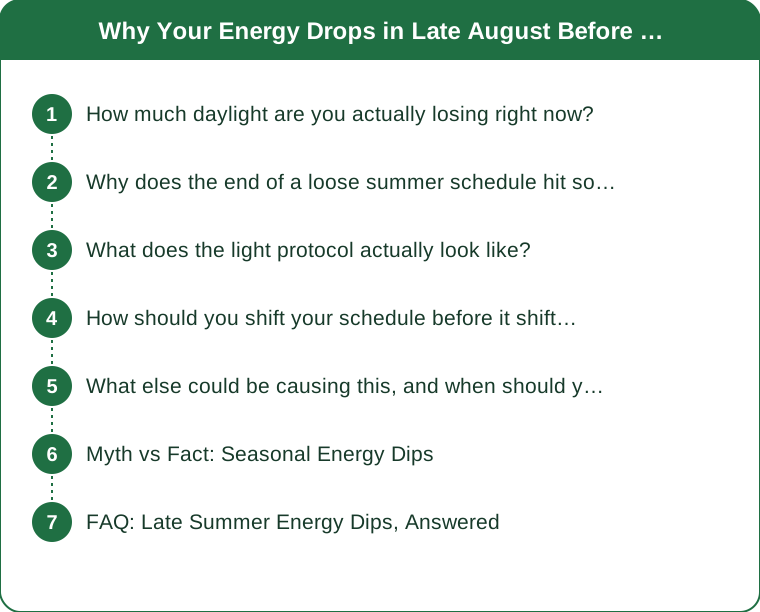
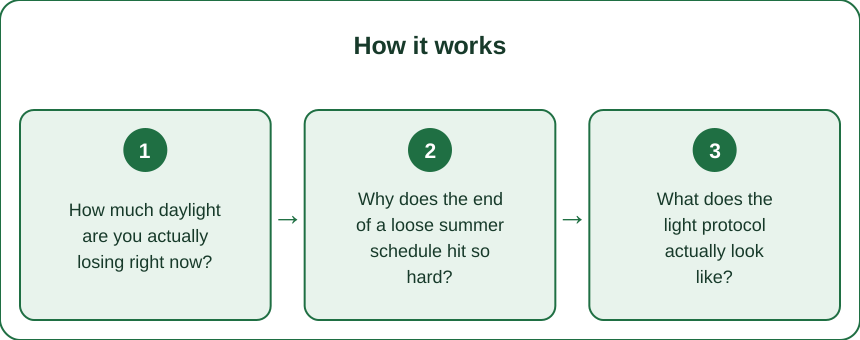
How much daylight are you actually losing right now?
More than it feels like, and the rate is accelerating.
The numbers. At mid-northern latitudes, from mid-August through September, daylight shortens at roughly 2 to 3 minutes per day. That is around 15 to 20 minutes per week and close to an hour and a quarter across the month of August’s second half and the first fortnight of September.
Why you do not perceive it day to day. Human perception of light is logarithmic - we notice ratios rather than absolute changes, and a 3-minute difference against a 14-hour day is far below the threshold of noticing. The change is genuinely invisible in the moment and genuinely substantial in aggregate, which is a bad combination for interpreting your own tiredness.
The part that matters most is not total daylight. It is the timing of sunrise. Total daylight loss is split between the two ends of the day, but the morning end is what your circadian system uses to set its phase. A sunrise that has moved 40 minutes later since early July means your strongest daily timing signal is arriving 40 minutes later, every day, without you deciding anything.
Sun angle compounds it. Even at the same clock time, the sun sits lower in the sky than it did in June, so the light arriving at your eyes is less intense and passes through more atmosphere. Morning light in late August is meaningfully weaker than morning light in midsummer even at identical times.
What this does biologically. Light hitting specialised cells in the retina suppresses melatonin and anchors the timing of the circadian clock. Weaker, later morning light means a later melatonin offset, which produces exactly the symptom people describe: waking up already tired, feeling foggy until mid-morning, and then feeling fine at 10pm when you should be winding down.
The practical implication. If your tiredness started sometime in the last two or three weeks and your sleep duration has not changed, light timing is the first thing to examine, ahead of diet, ahead of training load, ahead of anything you would normally suspect.
Why does the end of a loose summer schedule hit so hard?
Because summer was holding your rhythm in place with structure you did not notice you were using.
What summer provides that autumn does not:
- Outdoor time. Even a modest amount of outdoor activity delivers light levels 10 to 100 times higher than indoor lighting. A cloudy day outdoors is brighter than a well-lit office, and summer means you were outdoors incidentally, without planning it
- Later, more variable meal times, which are themselves a weaker but real timing signal
- More physical activity distributed through the day rather than concentrated in one gym session
- Warmth, which shifts how easily you wake - people wake more readily in warm rooms with light than in cool dark ones
What replaces it. A fixed early schedule, indoor days, and light exposure concentrated in the commute. The transition happens in a single week for most people, usually the week school or the office schedule resets, and a system that drifts by minutes a day is asked to shift by an hour at once.
The social jetlag mechanism. Through summer, weekend and weekday wake times converge. When the weekday wake time snaps an hour or ninety minutes earlier and the weekend does not follow, you produce a weekly rhythm equivalent to flying across a time zone every Friday and back every Monday. Research on social jetlag consistently links it to daytime sleepiness, low mood and worse metabolic markers - and late August is when it is created for the year.
Why it does not feel like a schedule problem. Because the tiredness is worst on Monday and Tuesday and improves by Thursday, people interpret it as a work problem or a motivation problem. The pattern - bad early week, better late week, reset by the weekend - is close to diagnostic of a rhythm mismatch rather than a fatigue disorder.
The window that matters. The two weeks before your schedule tightens are when this is cheap to fix. Shifting a wake time by 15 minutes every three days is effortless; shifting it by 90 minutes overnight is not.
What does the light protocol actually look like?
Front-load the day, and be specific about timing and duration.
Morning light, which is the single highest-value intervention:
- Within 30 to 60 minutes of waking, get outside. Not near a window - outside. Window glass and indoor lighting deliver a fraction of the intensity your circadian system needs
- 10 to 15 minutes on a clear morning, 20 to 30 on an overcast one. Overcast outdoor light is still far brighter than indoor light, but it takes longer
- No sunglasses during this window. The point is light reaching the retina
- Combine it with something you already do - the first coffee outside, the walk to the station, the dog. Anything requiring a new standalone habit will not survive September
Evening light, which is the half people skip:
- Dim overhead lights after sunset and use lamps at eye level or lower. Light from above is a stronger circadian signal than light from below
- The last 90 minutes before bed should be visibly dimmer than the rest of the evening. This is a bigger effect than screen filters
- Screens matter less than total room brightness at typical distances, though both help
If you cannot get outside in the morning:
- A 10,000 lux light box for 20 to 30 minutes at the same time each morning is the evidence-backed substitute
- Position it off to the side at eye level rather than staring at it, and use it while doing something else
- Consistency of timing matters more than duration. The same 20 minutes at the same time beats a variable 40
What to expect and when. Circadian phase shifts at roughly an hour per day at maximum, and realistically 20 to 30 minutes a day with consistent light. Give any protocol 5 to 7 days before judging it, because the first two days often feel like nothing.

How should you shift your schedule before it shifts you?
Gradually, starting from the wake end, beginning about two weeks out.
The staged wake shift:
- Work out the gap between your current wake time and the one your autumn schedule needs
- Move the wake time 15 minutes earlier every 2 to 3 days, not all at once. A 90-minute total shift takes about two weeks at this rate
- Set the alarm and get up - do not lie in. The wake time is the anchor; the bedtime follows it
- Keep the new wake time on weekends within an hour of the weekday one. This is the part people abandon and it is the part that does the work
Why you shift the wake time and not the bedtime. You cannot reliably fall asleep earlier by deciding to. Sleep onset follows the circadian phase, and the phase follows morning light exposure. Getting up earlier and getting light earlier moves the whole system; going to bed earlier just produces time lying awake.
The bedtime handles itself, with one exception. Sleep pressure builds through the day, so an earlier wake usually produces an earlier natural sleep onset within 3 to 4 days. The exception is caffeine, which can mask sleep pressure entirely.
Caffeine timing during a transition:
- Caffeine’s half-life is around 5 to 6 hours in most adults, meaning a 3pm coffee leaves a meaningful dose circulating at 9pm
- During a schedule shift, pull the last caffeine of the day back to 8 hours before your target bedtime. Return to normal once the shift is complete
- Delay the first coffee by 60 to 90 minutes after waking if you rely on it heavily - this is a small effect but it makes the natural morning cortisol rise do more of the work
Meal timing, which is a secondary but useful lever:
- Eat breakfast within an hour of waking during the transition, which reinforces the new phase
- Keep the evening meal at least 2 to 3 hours before bed. Late large meals raise core temperature at exactly the wrong point
Exercise as a timing signal. Morning or early afternoon training reinforces an earlier phase. Hard training within 2 hours of bed delays it in most people, though there is real individual variation here.
What else could be causing this, and when should you check?
Light and rhythm explain most late-August fatigue. They do not explain all of it, and a few alternatives are worth ruling out.
Things that legitimately look identical:
- Iron deficiency, which is common in menstruating women and produces exactly this presentation - tiredness that sleep does not fix, plus breathlessness on stairs and cold hands. Ferritin, not just haemoglobin, is the relevant test, and a normal full blood count does not rule it out
- Thyroid dysfunction, which adds cold intolerance, dry skin, and unexplained weight change
- Vitamin D, which declines through autumn and winter and starts declining now for people who were outdoors less than they think
- Sleep apnoea, suggested by snoring, waking unrefreshed after adequate hours, and morning headaches. It is substantially underdiagnosed in women because the classic presentation was defined in men
- Low mood or depression, which can present primarily as fatigue and reduced motivation before it presents as sadness
The dehydration factor, which is specific to this season. Late summer heat with an autumn schedule means people cut fluid intake back on the same week the weather is still hot. Mild dehydration reduces cognitive performance and reads exactly like tiredness.
The training-load factor. Summer often means higher incidental activity. If you have kept summer training volume while adding an autumn schedule, that is a genuine load increase, and cumulative fatigue is the correct interpretation rather than a circadian one.
Signals that warrant seeing a doctor rather than adjusting your light:
- Fatigue that has persisted more than a month despite good sleep and consistent morning light
- Fatigue with breathlessness, chest symptoms, or unexplained weight change
- Sleeping 9+ hours and still waking unrefreshed
- Fatigue accompanied by persistent low mood, loss of interest, or hopelessness
The reasonable order of operations. Fix light timing and wake consistency for two weeks first, because it is free and the effect is usually visible. If nothing has moved after two weeks of genuine consistency, that is the point to get bloods done rather than the point to try harder.
Myth vs Fact: Seasonal Energy Dips
Myth: You need more sleep as the days shorten. Fact: Sleep need is largely stable year-round. What changes is timing. Most people who add an hour of sleep and still feel tired have a phase problem, not a duration problem.
Myth: Seasonal tiredness only affects people in northern winters. Fact: Phase shifts happen wherever daylight changes across the year. The August-to-September transition is often felt more sharply than midwinter because the rate of change is fastest around the equinox, not the solstice.
Myth: Sitting by a bright window is the same as going outside. Fact: It is not close. Outdoor light on an overcast day is typically many times brighter than the brightest indoor space, and window glass cuts a substantial portion.
Myth: Going to bed earlier fixes it. Fact: You cannot force earlier sleep onset. Move the wake time and the morning light, and the bedtime follows within a few days.
Myth: Catching up at the weekend resets you. Fact: A two-hour weekend lie-in re-delays the phase you spent all week establishing, which is why Monday is the worst day. Weekend consistency within an hour is what breaks the cycle.
Myth: If you are tired, you should train less. Fact: Moderate morning or midday exercise reinforces an earlier circadian phase and generally improves energy during a transition. What hurts is hard training close to bedtime.
FAQ: Late Summer Energy Dips, Answered
Why am I tired in August when the weather is still good?
Daylight has been shortening by 2 to 3 minutes a day since June and sunrise has moved substantially later. Your body clock responds to light timing, not to temperature.
How long does it take to adjust to a new schedule?
About a week per hour of shift if you move gradually and get morning light. Shifting all at once typically takes two to three weeks to settle and feels much worse.
Is a sunrise alarm clock worth it?
For many people yes, particularly once sunrise falls after your wake time. It is a gentler wake and a weak circadian signal - useful, but not a substitute for actual outdoor morning light.
Should I take melatonin?
A low dose taken in the early evening can help shift phase earlier, but timing matters more than dose and it is easy to get wrong. Worth discussing with a pharmacist or doctor rather than guessing.
Why is Monday always the worst day?
Weekend lie-ins delay your circadian phase, so Monday morning arrives before your body is ready. Keeping weekend wake times within an hour of weekdays removes most of it.
When should I see a doctor about tiredness?
If it has lasted more than a month with consistent sleep and morning light, or comes with breathlessness, weight change, or persistent low mood. Ask about ferritin specifically, not just a standard blood count.
TL;DR:
- You are losing 2 to 3 minutes of daylight a day and sunrise has moved substantially later since July
- Morning light within an hour of waking, outdoors, 10 to 15 minutes clear or 20 to 30 overcast, is the highest-value fix
- Shift the wake time 15 minutes every 2 to 3 days rather than all at once, and keep weekends within an hour
- Move the wake end, not the bedtime - sleep onset follows the phase, and the phase follows morning light
- If two weeks of genuine consistency changes nothing, get ferritin and thyroid checked rather than trying harder
The reason late August tiredness feels inexplicable is that the cause moves too slowly to notice and adds up faster than you would guess.
Keep Reading
This article is for general informational purposes only and is not medical advice. Always consult a qualified health professional for guidance specific to you.