Why Do You Feel Exhausted the Moment You Wake Up, Even After 8 Hours?
Quick Answer: Waking up tired despite a full night’s sleep is often about when in your sleep cycle your alarm interrupts you, not how many total hours you got — waking mid-deep-sleep produces a grogginess called sleep inertia that can last 15-60 minutes regardless of total sleep time.
It’s one of the more frustrating fatigue patterns because it doesn’t respond to the obvious fix — more hours in bed doesn’t always solve it.

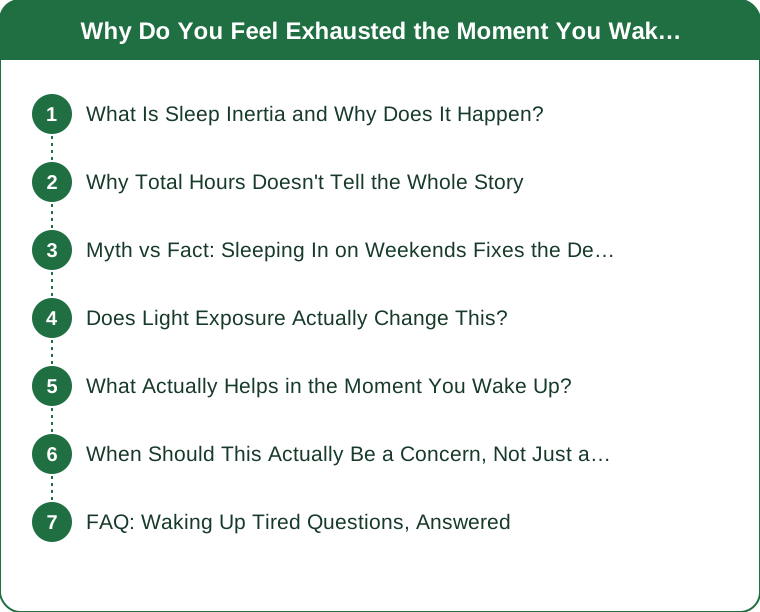
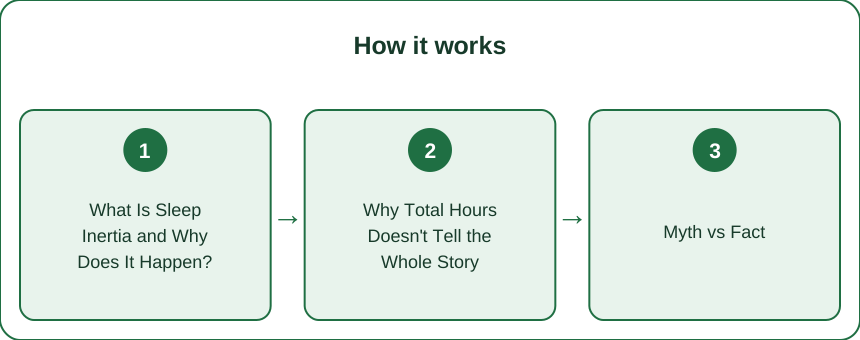
What Is Sleep Inertia and Why Does It Happen?
Sleep inertia is the grogginess and impaired alertness you feel right after waking, caused by your brain transitioning out of sleep more slowly than your body. It’s most intense when you’re woken from deep (slow-wave) sleep rather than lighter stages — and deep sleep tends to cluster in the earlier part of the night, with lighter stages becoming more common toward morning.
This means an alarm that goes off at a ‘bad’ moment in your cycle can leave you feeling worse than one that catches you in lighter sleep, even with identical total sleep duration.
Why Total Hours Doesn’t Tell the Whole Story
Sleep happens in roughly 90-minute cycles moving through light, deep, and REM stages. Two people can both sleep exactly 8 hours and have very different mornings depending on which stage their wake-up time landed in. This is why 7.5 hours timed well can genuinely feel better than 8 hours timed poorly — cycle alignment matters alongside duration, not instead of it.
Myth vs Fact: Sleeping In on Weekends Fixes the Deficit
Myth: sleeping in an extra 2-3 hours on weekends catches you up and resets how you’ll feel waking up during the week. Fact: inconsistent wake times actually disrupt your circadian rhythm further, often making Monday morning grogginess worse, not better — a phenomenon sometimes called ‘social jet lag.’ A consistent wake time, even on weekends, tends to produce better morning alertness over time than compensatory sleeping in.

Does Light Exposure Actually Change This?
Yes, meaningfully. Morning light exposure — even a few minutes near a window or outside — signals your circadian clock to suppress melatonin and ramp up cortisol’s natural morning rise, which is part of what shifts you out of sleep inertia faster. Waking up in a dark room and immediately opening a phone screen a few inches from your face doesn’t provide the same signal, and can leave the grogginess lingering longer.
What Actually Helps in the Moment You Wake Up?
A short burst of light movement (even just standing and stretching), splashing cool water on your face, and getting natural light within the first 20-30 minutes all measurably shorten sleep inertia in research. Caffeine helps too, but works on a delay of 20-30 minutes, so it’s addressing symptoms after the fact rather than the underlying transition.
What doesn’t help much: hitting snooze repeatedly, which fragments the tail end of your sleep further and tends to make the grogginess worse, not better, by the time you actually get up.
When Should This Actually Be a Concern, Not Just an Annoyance?
If grogginess regularly lasts more than an hour, or you’re waking unrefreshed despite consistent 7-9 hour sleep and good sleep hygiene, it’s worth considering whether something is disrupting your sleep quality itself — sleep apnea, restless leg syndrome, or other sleep disorders can all produce this exact pattern and are worth a conversation with a doctor. This is general information, not medical advice.
FAQ: Waking Up Tired Questions, Answered
Do sleep cycle alarm apps that time your wake-up actually work?
They can help somewhat by estimating lighter sleep stages through movement tracking, though accuracy varies by app and device — worth trying, but not a guaranteed fix.
Is it normal to need 30+ minutes before feeling fully awake?
Some sleep inertia is completely normal; it becomes worth addressing when it’s severe or lasts well over an hour most mornings.
Does napping during the day cause the same grogginess?
Yes — waking from a nap longer than 20-30 minutes risks hitting deep sleep and producing the same inertia effect, which is why short naps are usually recommended over long ones.
TL;DR:
- Waking mid-deep-sleep causes sleep inertia, independent of total sleep hours
- Sleep happens in ~90-minute cycles — timing matters as much as duration
- Sleeping in on weekends often worsens weekday grogginess rather than fixing it
- Morning light exposure and movement shorten sleep inertia faster than snoozing
If more hours in bed hasn’t fixed your morning fog, the timing of your wake-up — not the length of your sleep — might be the actual lever to pull.
Keep Reading
This article is for general informational purposes only and is not medical advice. Always consult a qualified health professional for guidance specific to you.